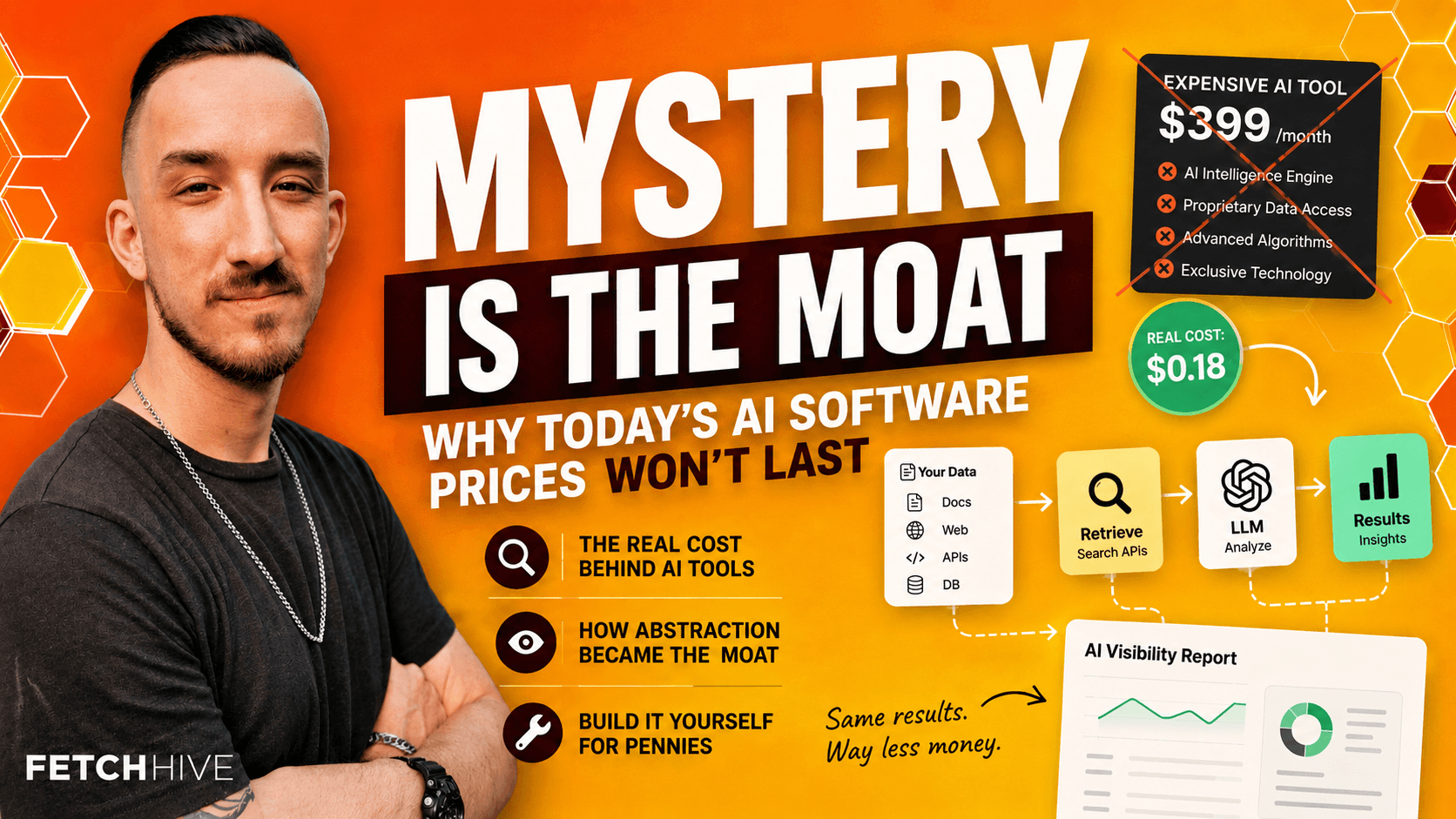
Mystery Is the Moat: Why Today's AI Software Prices Won't Last

By
Tom Dallimore
Published
I have been thinking about AI pricing quite a lot recently, partly because I spend so much time looking at what actually happens underneath AI products.
Models, APIs, search providers, prompts, tool calls, workflows, infrastructure, token usage, whatever. All the boring stuff that sits underneath the nice dashboard somebody eventually sells you.
And the more I look at it, the more I think we have created a slightly ridiculous situation.
AI is becoming easier to access, models are becoming cheaper to run, search and data APIs are becoming widely available, and businesses are spending more money on AI than ever before.
At the same time, we have an entire industry appearing that often makes the technology sound considerably more mysterious than it actually is.
I don't think that lasts.
In fact, I think one of the biggest moats protecting a lot of AI companies today has absolutely nothing to do with proprietary technology.
The moat is that the customer doesn't know how the product works.

And once more people do, pricing is going to get very interesting.
AI Spending Has Gone Completely Mental
Before I start complaining about pricing, it is worth understanding just how much money is currently pouring into AI.
Gartner expects worldwide AI spending to reach $2.59 trillion in 2026, up 47% from the previous year. That includes an enormous amount of infrastructure, hardware and hyperscaler spending, so I am obviously not suggesting companies are spending $2.59 trillion on little AI SaaS dashboards. But it gives you an idea of the amount of money moving into the industry.
The application layer is growing incredibly quickly too.
Menlo Ventures estimates that enterprise generative AI spending increased from $11.5 billion in 2024 to $37 billion in 2025, with roughly $19 billion going into user-facing AI applications rather than the underlying models and infrastructure. According to its estimates, enterprise generative AI has gone from a $1.7 billion market in 2023 to $37 billion only two years later.
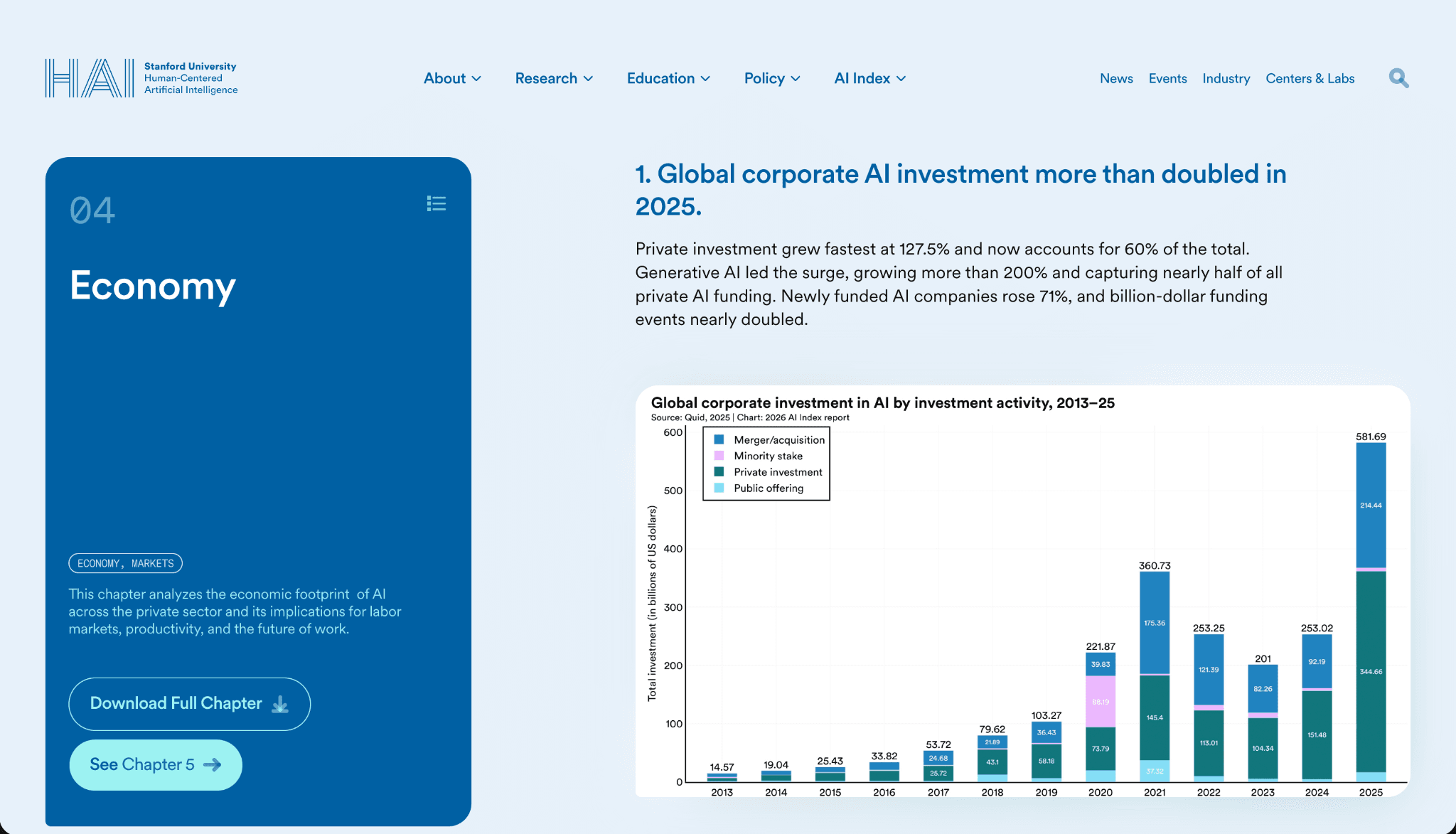
Stanford's 2026 AI Index tells a similar story. Global corporate AI investment more than doubled during 2025, private investment grew 127.5%, and investment specifically into generative AI grew by more than 200%. At the same time, AI adoption inside businesses continues to climb, with 88% of surveyed organizations reporting AI use and 70% using generative AI in at least one business function.
So yes, there is an absolutely stupid amount of money going into this stuff.
That creates opportunity, but it also creates exactly the environment where pricing becomes weird.
Businesses know they need AI. Management wants an AI strategy. Investors want AI growth. Departments suddenly have budgets for AI products, and the people approving those budgets often have very little idea what the technology underneath those products actually costs or how difficult it would be to reproduce.
That information gap matters.
Because something completely different is happening underneath all that spending.
The Technology Is Getting Cheaper at a Ridiculous Rate
This is the part of the AI market I think a lot of normal businesses still do not fully appreciate.
The amount companies are spending on AI is increasing dramatically, while the cost of accessing a given level of AI capability has been falling dramatically.
Stanford's 2025 AI Index looked at models capable of achieving approximately GPT-3.5-level performance on the MMLU benchmark. In November 2022, reaching that level of performance cost around $20 per million tokens. By October 2024, the cheapest model reaching the same threshold cost about $0.07 per million tokens.
That is more than a 280-fold reduction in around 18 months.
Epoch AI has looked at this across several different benchmarks rather than one performance threshold. Its researchers found that the price required to achieve equivalent performance had been falling at very different rates depending on the task, ranging from roughly 9x to 900x per year across the trends they measured, with a median of around 50x. They also explicitly warn that the fastest rates are recent and should not simply be extrapolated forever, which is fair enough because otherwise we eventually end up being paid by the API for asking it questions.
Even the underlying hardware keeps improving. An Epoch analysis published in August 2026 estimates that the average performance obtained per dollar spent on AI chips has improved by around 49% per year since 2023, which works out to roughly a doubling every 1.7 years.
The exact numbers will move around depending on what benchmark, model and workload you care about. The direction is the important part.
Useful AI capability keeps getting cheaper.
That should probably affect how you think about the price of software whose main job is packaging that capability.
A Lot of the Pieces Are Already Available to You
This is where things get even more interesting.
It is not only the models becoming accessible. The tools around the models are becoming accessible too.
OpenAI currently exposes powerful models directly through its API, including lower-cost models designed specifically for high-volume workloads. Its current GPT-5.6 Luna pricing, for example, is $0.20 per million input tokens and $1.20 per million output tokens.
Need search?
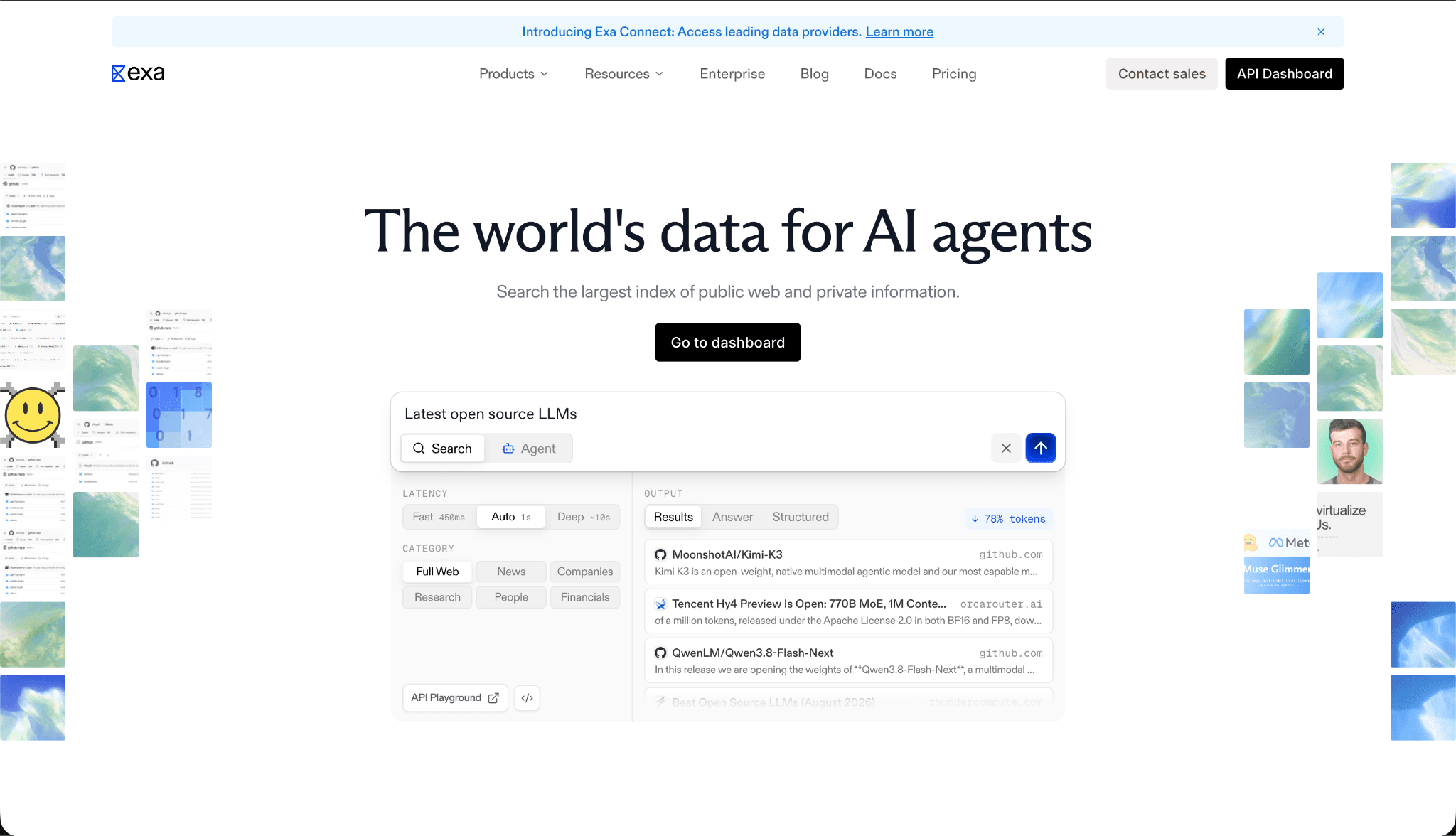
Exa currently charges $7 per 1,000 standard search requests and gives developers free monthly credits. Its deeper search APIs cost more, but we are still talking about cents per operation rather than some mysterious enterprise-only data feed.
Google exposes Google Search grounding through the Gemini API too. Its current pricing includes thousands of search requests each month before paid search-query pricing applies.
There are APIs for crawling websites, extracting pages, searching news, analyzing documents, generating structured data, classifying results, comparing competitors and a ridiculous number of other things.
And no, I am not suggesting every AI product can be reproduced by signing up for three APIs on a Tuesday afternoon.
Some products are genuinely complicated.
What I am saying is that the average person would probably be surprised by how many supposedly complicated AI products are ultimately built from technology that they can access themselves.
That distinction is important.
Take AI Brand Visibility as an Example
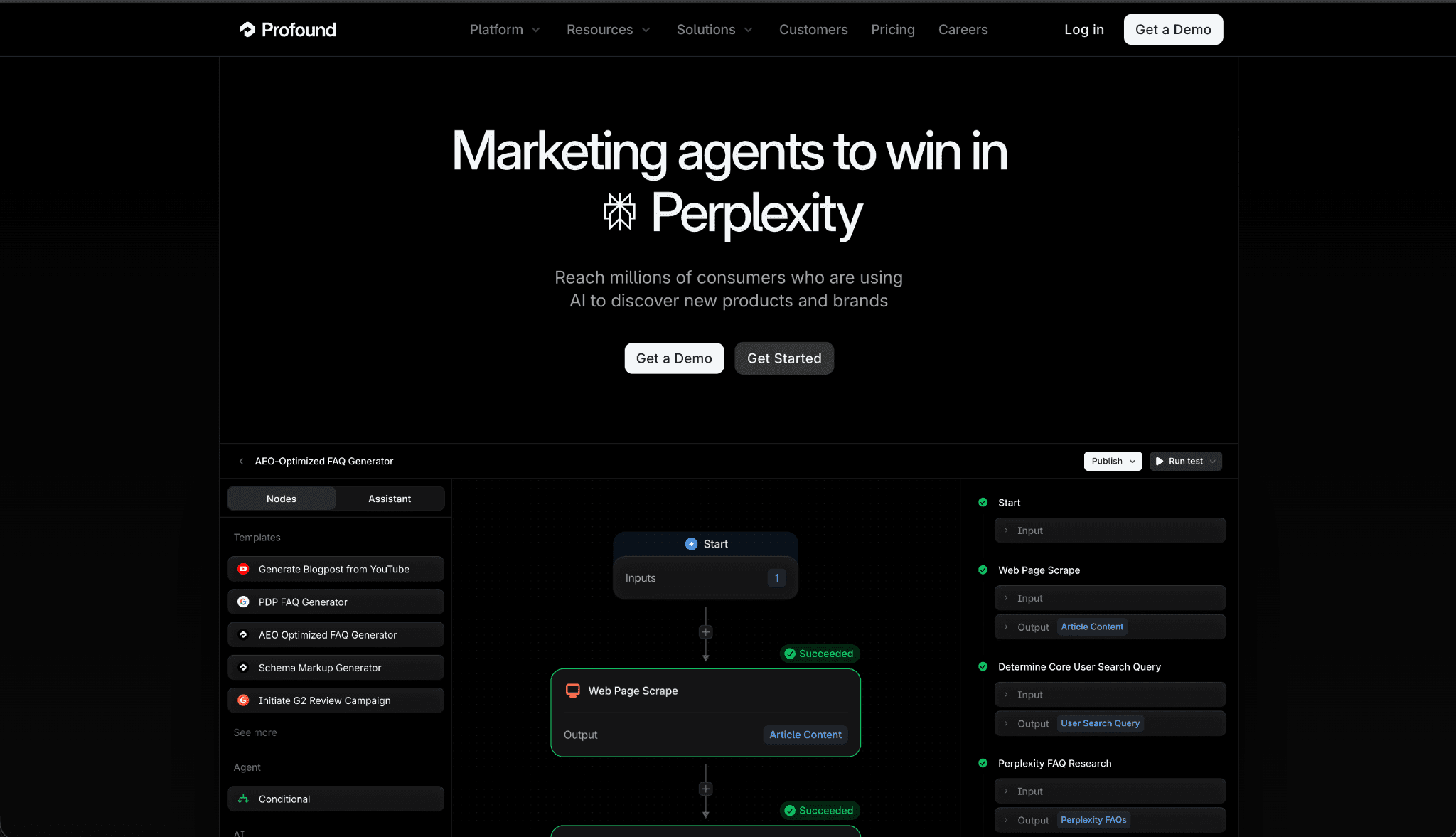
AI visibility is a good example because I have worked in this area and understand what is happening underneath it.
Companies want to know whether ChatGPT, Gemini and other AI systems mention their brand. They want to know which competitors appear, which websites get cited, how frequently they are recommended, whether answers are changing and what they might be able to do about it.
Those are perfectly reasonable things to want to know.
Where I disagree with parts of the market is the idea that this information necessarily needs to be presented as some sort of inaccessible black-box intelligence that only one company can obtain for you.
Strip the product down to the actual job and a lot of it becomes much easier to understand.
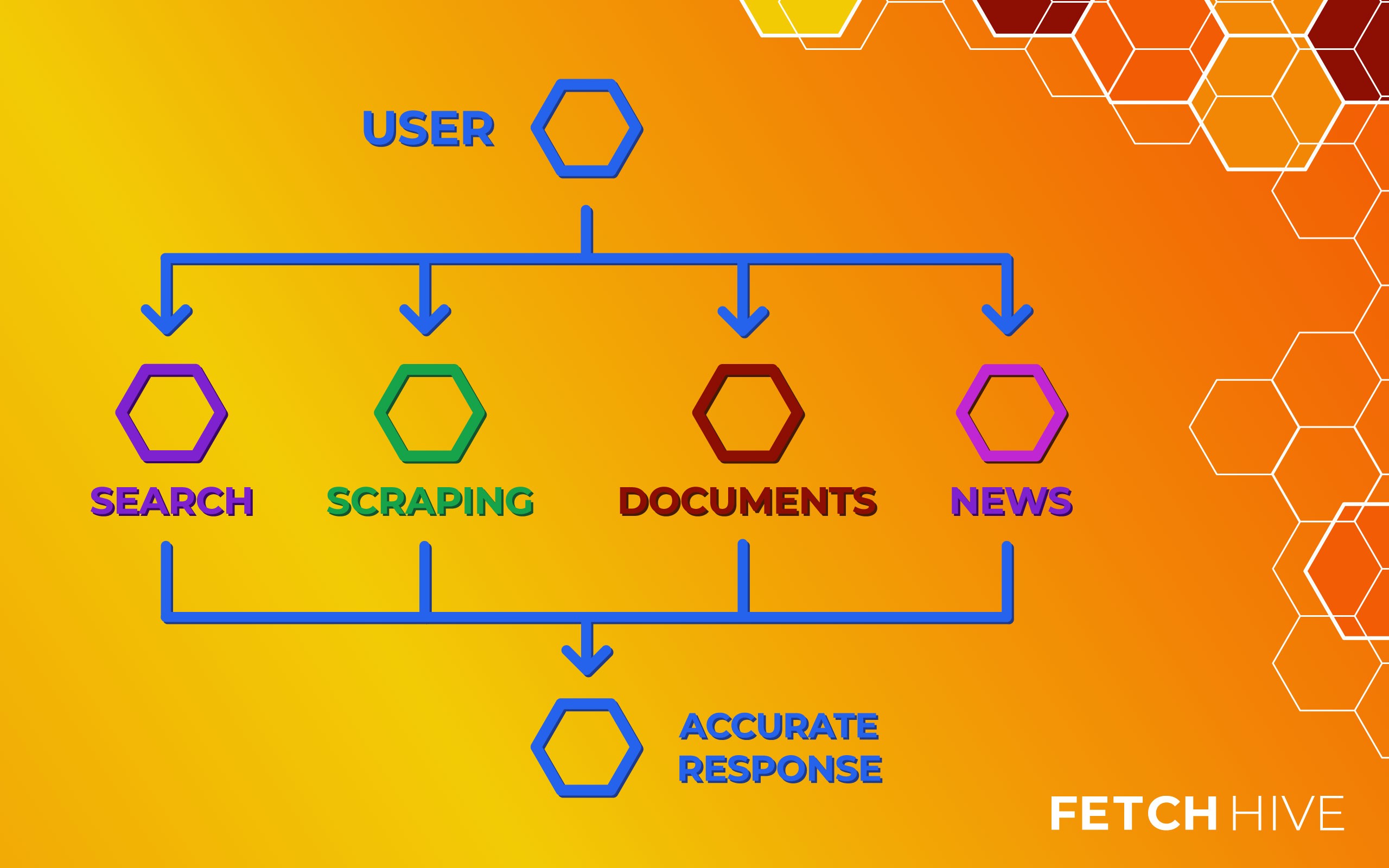
You query systems or search providers, collect responses, extract brands and citations, normalize the information, store it, compare it over time and use models to analyze what changed.
The exact implementation can obviously become considerably more sophisticated than that. A good product might have a properly designed methodology, historical data, prompt sampling, geographic segmentation, noise reduction, reporting, alerts, collaboration features and people who genuinely understand how to interpret the results.
Those things have value.
But there is an enormous difference between selling that value and allowing customers to believe that the underlying information itself is impossible to access without you.
In many cases, it isn't.
That is the bit I want more people to understand.
Abstraction Is Not Just Protecting the Margin
I originally thought about this as companies using abstraction to protect their margins.
The customer does not see the API calls, compute costs or workflow, so the company can charge considerably more for the finished product than the underlying operation costs.
But I actually think that description undersells what is happening.
For some AI companies, abstraction is the moat.
The perceived defensibility of the business depends on the customer believing there is something underneath the interface that would be extremely difficult for them to reproduce.
That might be completely legitimate. Maybe there really is proprietary data underneath it. Maybe the company has spent years developing specialist infrastructure. Maybe the product includes experts doing work behind the scenes. Maybe there are complicated integrations, compliance requirements, operational knowledge or network effects that would be painful to reproduce.
But sometimes the abstraction itself is doing most of the work.
The customer thinks they are buying access to some extraordinary AI capability, when in reality the company has assembled capabilities that are already commercially available and put a much nicer interface around them.
Again, that does not automatically make the product bad.
Packaging things properly is basically the entire software industry.
The problem starts when the packaging is deliberately confused with the underlying capability.
Because once customers understand the difference, the moat can disappear very quickly.
The Question Changes Once You Understand the Machinery
Imagine somebody offers you an AI research service for $400 per month.
If you believe the company has access to proprietary information, specialist AI models and technology you could never realistically reproduce, $400 might sound perfectly reasonable.
Now imagine somebody shows you how the system actually works.
It performs ten searches using commercially available APIs, sends the results through a model, extracts some structured information, compares it against previous results and generates a report.
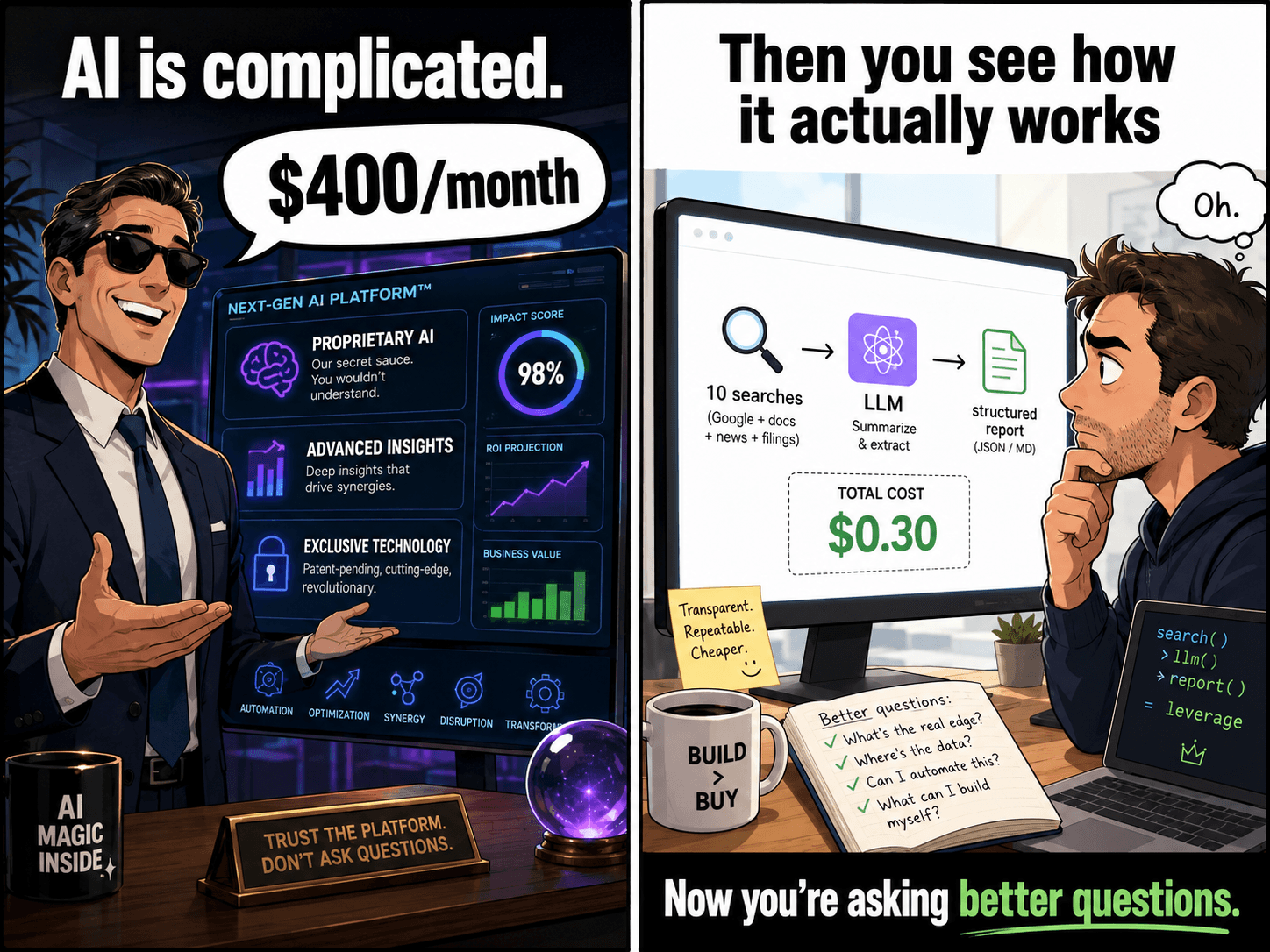
Maybe the underlying run costs $0.30.
That does not automatically mean the company should charge you $0.30. That would be an incredibly stupid way to price software.
But your perception of what you are buying has changed.
Now you can ask much better questions.
Is their historical database valuable? Is their methodology better than something I could build? Are the reports useful? Does the automation save me enough time to justify the subscription? Do they have expertise I do not have? Will maintaining my own version become a pain in the arse six months from now?
Those are sensible questions.
"AI is complicated, therefore $400" is not.
Do Some Research Before Buying Another AI Subscription
This is really the main point of this article.
I want people to become more curious about the AI products they buy.
You do not need to become an engineer. You definitely do not need to start training your own language model because you wanted a competitor report.
Just spend a little time understanding what the product actually does.
If you are looking at an AI tool that monitors competitors, search for competitor data APIs. If it researches companies, look at search and enrichment APIs. If it generates reports, try giving the same source material to ChatGPT, Claude or Gemini and see what happens. If it monitors something every day, think about whether the underlying job is simply a scheduled workflow.
Ask an AI model how it would build the system.
Search GitHub.
Look at the API documentation.
Look at the pricing.
You might discover that reproducing the product would be far too much work and the subscription suddenly looks like excellent value.
Perfect.
Buy it.
But you might also discover that you are about to pay $300 every month for something you could reproduce well enough for your needs with $5 of API usage and an afternoon of setup.
That is useful information too.
This Does Not Mean Every Expensive AI Product Is a Rip-Off
I want to be clear about this because otherwise the argument becomes stupid.
The underlying compute cost of software is not the same thing as the value of the software.

If a product costs $500 per month but saves your company $5,000 worth of employee time, who cares if the API calls underneath it cost $4?
The company built the product. It maintains the infrastructure. It handles failures. It improves the workflow. It builds the interface. It supports customers. It might provide analytics, historical data, security, compliance, collaboration and specialist knowledge on top.
That is what you are paying for.
I have absolutely no problem with that. I run a software company. I would be creating a slightly awkward business model for myself if my position was that software should only be allowed to charge customers the AWS bill plus 10%.
The issue is artificial mystery.
If a company can explain what value it adds after you understand the underlying technology, it has nothing to worry about.
If understanding the underlying technology makes you question why the company exists at all, that is a different problem.
I Don't Think Today's AI Prices Survive
Nobody can tell you exactly what an individual SaaS product will cost in 2027 or 2028, obviously.
But I find it incredibly difficult to believe that the current pricing environment remains intact.
Think about what is happening simultaneously.
Enterprise spending on generative AI went from $11.5 billion to $37 billion in one year. Corporate investment is exploding, with generative AI investment growing more than 200% in 2025. Meanwhile, equivalent model capability has historically been getting drastically cheaper, search infrastructure is available directly through APIs, hardware price-performance continues to improve and new competitors enter the model market constantly.
That combination creates enormous short-term opportunity for AI startups.
It also creates enormous long-term pricing pressure.
As customers understand AI better, they become harder to impress with products whose main selling point is simply "we connected an LLM to something."
As developers get better tools, similar products become easier to build.
As models get cheaper, the cost of experimenting drops.
As open models improve, more workloads stop depending on one vendor.
And as companies start asking what their AI software is actually doing, products protected primarily by abstraction have a much harder time maintaining artificial scarcity.
The companies with real value will be fine.
The companies whose main advantage is that their customers have no idea what is going on underneath the dashboard?
I would be considerably less relaxed.
This Is Why I Want Fetch Hive to Go in the Opposite Direction
WARNING: Shameless self-promotion incoming.
One of the things I have become increasingly obsessed with while building Fetch Hive is transparency.
If you build a workflow or agent, I want you to be able to see what actually happened. Which model ran, which tools it called, how long each part took, what it cost, what failed and where your money is going.

I don't want the cost of AI hidden behind some vague monthly usage meter where you have absolutely no idea whether the thing you just ran cost $0.02 or $2.
But I also want to take that philosophy further.
If there is an AI service people are paying hundreds of dollars for and the underlying job can reasonably be reproduced using publicly accessible tools, I want to show people.
Not by writing another article saying "you could probably build this yourself."
Actually show them.
Build the workflow.
Let them run it.
Show the result.
Show the tools.
Show what it cost.
Then let them decide.
Maybe they will still prefer the dedicated SaaS product because it has years of historical data, a better interface and a team of experts behind it.
Fine.
At least they now understand what they are paying for.
And maybe they look at the workflow and think:
"Wait. That's it?"
Also fine.
AI Should Become Less Mysterious, Not More
I think we are currently in a strange transition period.
AI is powerful enough that businesses are desperate to buy it, but still unfamiliar enough that many customers cannot properly evaluate what they are buying.
That gap creates huge opportunities for good companies. It also creates opportunities to package relatively accessible technology as something considerably more exclusive than it really is.
I don't think the gap stays open for long.
Generative AI reached 53% adoption in roughly three years according to Stanford's 2026 AI Index, faster than either the personal computer or the internet reached comparable adoption.
People are learning this stuff quickly.
In another few years, understanding models, tools and AI workflows is going to be considerably more normal than it is today.
The same thing happened with websites.
There was a time when simply being able to build a website seemed like some dark technological art. Companies could charge absurd amounts of money because the customer had absolutely no idea what was involved.
Then WordPress happened. Shopify happened. Squarespace happened. Developers became more common. Documentation improved. Open-source software improved. Customers became more technically literate.
You can still build an incredibly valuable web development company today.
You just cannot charge somebody £50,000 for a five-page brochure website because you convinced them HTML is witchcraft.
AI is heading in the same direction.
The easy access is already arriving.
The understanding will follow.
Final Thought
I don't think the lesson here is "stop paying for AI software."
That would be ridiculous.
The lesson is to understand what you are paying for.
AI spending is exploding at exactly the same time that the underlying capabilities are becoming cheaper and more accessible. That creates a temporary period where the difference between perceived complexity and actual complexity can become enormous.
Some companies will use that period to build genuinely excellent products with real defensibility.
Others will build a dashboard around technology you can access yourself and hope you never look behind the curtain.
So look behind the curtain.
Research the APIs. Try the models yourself. Search for the underlying data. Ask how you would reproduce the workflow. Work out which parts are actually difficult and which parts are just being presented as difficult.
Then make the decision.
If the software still looks worth $400 every month, brilliant. You are paying for something you understand and value.
If your reaction is:
"Hang on. I can do this myself."
Well...
That is exactly why I don't think a lot of today's AI pricing is going to last.
Research Links Used for This Article
Pricing, spending and market figures checked September 1, 2026. AI changes ridiculously quickly, so check current provider pricing before building a financial model around any of these numbers.
Gartner's 2026 worldwide AI spending forecast estimates $2.59 trillion in AI spending, up 47% year over year. Gartner - Worldwide AI Spending Forecast 2026
Menlo Ventures estimates enterprise generative AI spending reached $37 billion in 2025, including $19 billion spent at the application layer. Menlo Ventures - State of Generative AI in the Enterprise 2025
Stanford's 2026 AI Index covers investment growth, adoption and the wider economic impact of AI. Stanford HAI - 2026 AI Index: Economy
Stanford's 2025 AI Index documents the more than 280-fold reduction in the cost of reaching GPT-3.5-level MMLU performance between November 2022 and October 2024. Stanford HAI - 2025 AI Index: Research and Development
Epoch AI tracks the decline in inference prices required to reach equivalent levels of model performance across several benchmarks. Epoch AI - LLM Inference Price Trends
Epoch AI also estimates that performance per dollar for AI chips purchased each quarter has improved by around 49% per year since 2023. Epoch AI - AI Chip Performance Per Dollar
For examples of directly accessible AI infrastructure, see current pricing from OpenAI, Exa and Google's Gemini Developer API. OpenAI API Models Exa API Pricing Gemini Developer API Pricing
Share this post