Adaptive RAG vs Corrective RAG: Two Ways to Fix Weak Retrieval

By
Tom Dallimore
Published
Most RAG failures get blamed on the model. The answer is wrong, so someone swaps the LLM, adds a bigger prompt, or tweaks generation settings and hopes for the best. But if retrieval handed the model the wrong document, none of that fixes the actual problem. You just get a more expensive wrong answer.
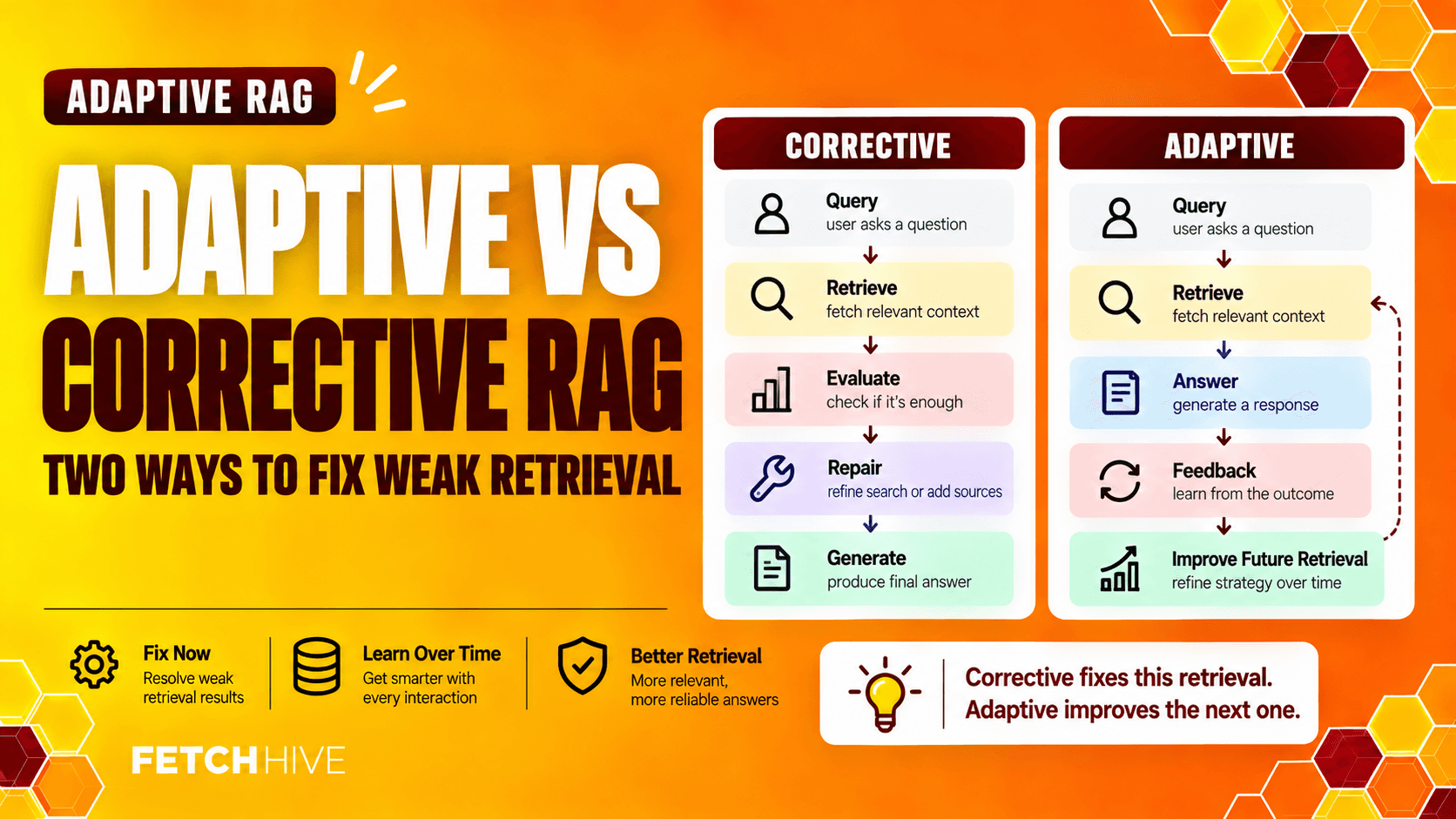
Adaptive RAG and corrective RAG attack weak retrieval from two different directions. Corrective RAG catches a bad retrieval during the current query and fixes it before generation. Adaptive RAG uses feedback and historical performance to make the retrieval system less likely to repeat the same mistake later. In practice, the strongest production systems can use both.
That distinction matters because retrieval augmented generation is only as useful as the context it retrieves. A large language model can write a beautifully confident final answer from completely irrelevant content. The difficult bit is making sure the right information reaches the model in the first place.
Adaptive vs Corrective RAG: The Short Version
The simplest way to think about the two approaches is this: corrective RAG is a quality gate for the answer you are producing now; adaptive RAG is a feedback loop for improving the system you will use next time.
Corrective retrieval augmented generation adds a retrieval evaluator between retrieval and generation. It looks at the retrieved documents, estimates document relevance and confidence, and decides whether the context is good enough. If it is not, the system can trigger different knowledge retrieval actions such as query rewriting, filtering, another vector store lookup, or a web search tool before the generator sees anything.
Adaptive RAG works on a longer horizon. It looks at retrieval results, user feedback, evaluator scores and recurring query patterns, then changes routing, weights, thresholds, indexing or query transformations. The point is not to rescue one answer. It is to make future retrieval better.
You do not have to choose one forever. Corrective RAG can protect a high-risk workflow today while adaptive policies use the same logs to reduce how often that corrective branch is needed tomorrow.
Dimension | Corrective RAG | Adaptive RAG |
Primary job | Fix weak retrieval in the current query | Reduce repeat retrieval failures over time |
When it acts | Inside the current request | Across or alongside many requests |
Main mechanism | Retrieval evaluator + corrective actions | Feedback + routing, indexing and threshold changes |
Latency impact | Extra work when correction is triggered | More optimization can happen asynchronously |
Best fit | High-risk answers and low error tolerance | Repeat queries, changing data and evolving workflows |
Rule of thumb: Need trust on this answer? Lean corrective. Want fewer repeat failures later? Lean adaptive. Need both? Use both. |
Why Retrieval-Augmented Generation Still Needs Fixing
Picture a construction accounting assistant used by a project manager. They ask which payment terms apply to a subcontractor change order. The system retrieves a contract, except it is the superseded version. The large language model does exactly what it was asked to do: it reads the retrieved context and gives a polished answer based on stale information.

That is the annoying thing about traditional RAG. When retrieval is wrong, generation can still look completely convincing. The system may miss the most relevant documents, rank a similar-but-wrong chunk above the correct one, pull old policies from a knowledge base, or return too little context and fill the gaps itself.
For construction teams, accounting firms and other businesses using AI for job costing, WIP reporting, compliance or customer-facing answers, that is not a cosmetic problem. One bad document can flow into a final response, then into a workflow, then into a real business decision. The field team eventually discovering the mistake two weeks later is not exactly the observability strategy we are aiming for.
Before adding clever agents, evaluators and fallback logic, it is still worth fixing the basics. Good chunking, metadata, embeddings, hybrid retrieval and reranking solve a lot of weak retrieval without any adaptive or corrective machinery. If the underlying search is bad, wrapping it in more AI does not magically make it good.
Key Components of a Modern RAG Stack
Both approaches share the same basic RAG bones. The key components are familiar; what changes is where the system makes decisions and how it learns from failure.
Retriever: The search layer that pulls candidate passages. Retrieval may use dense or sparse search, hybrid retrieval, a vector store, SQL, graph retrieval or other data sources.
Knowledge base: The documents and structured data the system can search. This can include policies, support content, contracts, change orders, ERP exports, product docs and external sources.
Retrieval evaluator: A scoring component that judges the relevance, completeness and trustworthiness of retrieved information before the generator relies on it.
Generator: A large language model that turns the retrieved context into the answer the user actually sees.
Feedback loop: Logs, evaluator decisions, corrections and user signals that tell the system where retrieval succeeded or failed.
Corrective RAG focuses heavily on the retrieval evaluator at query time. Adaptive RAG uses many of the same signals over a longer period. Same ingredients, different control loop.
What Is Corrective RAG (CRAG)?

Corrective RAG, usually shortened to CRAG, puts an explicit quality check between retrieval and generation. The idea from Yan et al. is straightforward: do not let the generator see weak context just because the first retrieval completed successfully.
The process starts with a user question. The retriever gathers relevant documents from the knowledge base. A retrieval evaluator then scores the retrieved documents and assigns a confidence degree to the batch: correct, ambiguous or incorrect. If the evidence is strong, the pipeline continues. If it is weak, corrective actions fire.
Those actions can include rewriting the query, filtering irrelevant details, decomposing noisy documents, trying another retriever, or triggering large scale web searches. CRAG uses a decompose then recompose algorithm to isolate useful pieces from longer documents and rebuild a cleaner context set. The point is not to retrieve more for the sake of it. It is to stop irrelevant content reaching the final answer.
The original CRAG experiments used four datasets covering short-form QA and long form generation tasks. The paper reported gains across PopQA, Biography, PubHealth and ARC-Challenge, with the largest reported accuracy improvement on PubHealth. That is useful evidence for the basic idea: evaluate retrieval quality before asking generation to clean up the mess.
CRAG also supports fallback retrieval when internal sources are not enough. A web search can expand the evidence set, while the evaluator decides what should survive into the final context. This makes corrective RAG relatively plug and play with an existing RAG pipeline: you are adding a quality gate and recovery path rather than replacing the entire system.
The trade-off is obvious. Extra evaluation and extra retrieval can add latency and cost. CRAG improves factuality when it catches bad context, but if every query takes a scenic tour through three models and five tools, you have created a different problem.
When CRAG works well, the recovery path is there when you need it and invisible when you do not.
What Is Adaptive RAG?
Adaptive RAG works differently. Instead of only asking, “Is this retrieval good enough right now?”, it asks, “What should we change so this kind of query works better next time?”
In the framing used here, adaptive systems learn from repeated retrieval results, evaluator scores, user corrections and changing data. Adaptive runs can happen alongside the serving path, with changes applied asynchronously rather than making every request wait for a full optimization cycle.
There are a few useful levers. Query rewriting can learn organization-specific language. A construction team might repeatedly use “CO” to mean “change order”, so the system can rewrite that query before retrieval. Retriever routing can learn that keyword retrieval works better for exact job costing numbers while semantic search works better for conceptual questions. Knowledge base maintenance can re-index new policies, retire stale documents and prefer the latest version. Threshold tuning can adjust when a retrieval evaluator should intervene.
For static and limited corpora, this may not buy you much. If the same small document set rarely changes and users ask straightforward questions, traditional RAG with good retrieval may already be enough. But limited corpora that evolve over time, or systems with thousands of repeated queries, create more useful feedback.

Imagine an AI assistant used by accounting firms. Over a quarter, it learns which document types, GL codes and fields most often resolve invoice disputes. The system does not need to blindly perform RAG the same way forever. It can shift routing and ranking based on observed accuracy and overall quality.
That is the appeal of adaptive retrieval: the system is not only producing answers; it is collecting evidence about how retrieval itself should improve.
Adaptive vs Corrective RAG: How They Actually Differ
Both approaches are trying to fix the same thing, but they work at different points in the lifecycle.
Corrective RAG is immediate. It runs knowledge retrieval actions inside the current request, catches low-confidence context and tries to repair it before generation. Adaptive RAG is cumulative. It looks across many queries and changes the retrieval behavior itself.
That creates different metrics. Corrective systems care about evaluator confidence, document relevance, citation correctness, fallback rate and the percentage of queries that need another retrieval. Adaptive systems care about trends: first-answer accuracy, fewer escalations, reduced retries, better routing decisions and whether the same failure happens less often over time.
There is also a performance trade-off. Corrective evaluation adds work to the serving path. Adaptive optimization can push more of that work offline, although re-indexing and evaluation still cost money somewhere. In practice, various RAG based approaches blend the two: adaptive policies reduce the number of failures, and a corrective gate catches the ones that remain.

Inside a Corrective RAG Pipeline
If you implement CRAG, keep the flow boring enough that you can debug it. The plan should be obvious from the trace. A sensible corrective pipeline looks like this:
Retrieve candidate documents from the vector store, keyword index, cache or other relevant data sources.
Score every retrieved document with the retrieval evaluator. Capture relevance, freshness, source quality and a confidence degree.
If retrieval is correct, continue. If it is ambiguous or incorrect, trigger different knowledge retrieval actions: rewrite the query, invoke a web search tool, change retriever, filter irrelevant content, or run the decompose then recompose algorithm.
Evaluate the new retrieval results again. Keep the key information and throw away the noise.
Pass the vetted retrieved context to the language model and generate the final answer with citations.
Log the query, retrieved information, evaluator decisions, corrective branch, tool calls and final response.
Kensink Labs reports a production example where only a small percentage of queries triggered the corrective path, so the expensive branch was reserved for the awkward long-tail cases. That is the pattern I prefer: make the fast path fast, and spend extra work only when the system has evidence that it needs it.
A lightweight retrieval evaluator can help here. You usually do not need your most expensive model to answer “Are these documents relevant enough?” Save the larger model for generation if that is where it produces meaningful quality gains.
Inside an Adaptive RAG Pipeline
Adaptive RAG keeps the same retriever-generator foundation but adds a learning loop around it. The serving path stays focused on answering the user; the adaptive layer watches what happened and changes future behavior.
Dynamic query rewriting is one lever. If users consistently phrase the same thing in organization-specific shorthand, the system can normalize those queries automatically. Retriever routing is another. If historical evaluation shows that exact keyword search beats vector retrieval for numerical questions, route those queries accordingly instead of forcing one retrieval method onto everything.
Then there is document maintenance. New files arrive, old files become stale, and multiple versions coexist. Adaptive policies can trigger re-chunking, re-embedding or re-indexing when the data changes. They can also change search weights and evaluator thresholds when feedback shows that the current settings are too strict or too permissive.
The AIR-RAG framework is one example of this iterative approach: feedback is used to improve retrieval behavior without retraining the base large language models. The important bit for implementation is not the name of the framework. It is having enough structured feedback to know what to change.
The Retrieval Evaluator Is More Important Than It Looks
The retrieval evaluator is easy to treat as a small implementation detail. It is not. It plays a significant role in both corrective and adaptive systems because it converts “that answer felt bad” into something you can actually measure.
For corrective RAG, the evaluator is active control logic. It decides whether the current retrieval is correct, whether there is enough information, and whether another action should run. For adaptive RAG, the evaluator becomes historical data. Across thousands of queries, you can see that a certain document type has poor relevance, a route produces weak answers, or a specific query pattern causes repeated fallbacks.

Useful evaluation signals include document relevance, source freshness, duplication, contradictions, citation support and answer accuracy. A lightweight retrieval evaluator can keep this step cheap enough to use regularly, while a more capable language model handles the harder generation work.
For regulated teams, log those decisions. If customers, auditors or internal reviewers ask why the system produced an answer, “the model said so” is not a great audit trail. You want the retrieved documents, the evaluator scores, the tools called and the context that actually reached generation.
This is also why I care so much about traces in Fetch Hive. If a RAG answer is wrong, I want to see the retrieval results, tool calls, model requests, cost and failures rather than staring at the final answer and guessing which part went sideways.
When Should You Favor Adaptive vs Corrective RAG?
Favor corrective RAG when:
A compliance assistant where a superseded regulation cannot be allowed into the answer.
Financial reporting or audit workflows used by accounting firms where wrong numbers can flow into workpapers.
AI agents performing close, consolidation or other high-risk business processes.
Customer-facing workflows where one confidently wrong response creates immediate reputational or financial risk.
Favor adaptive RAG when:
Internal search across fast-moving wikis, product docs and engineering knowledge.
Construction documentation where RFIs, submittals and change orders appear every week.
Repeated job costing and WIP reporting queries where the same patterns show up with small variations.
Long-running AI agents where retrieval routes can improve from user corrections and recurring workflow data.
A simple rule: if you need trust on this answer, lean corrective. If you expect the same class of query again and again, lean adaptive. If both are true, use both.
Designing Adaptive and Corrective RAG for AI Agents

AI agents make retrieval quality even more important because one workflow can perform RAG several times before the user sees anything. If you want the broader architecture first, our guide to how Agentic RAG systems plan, retrieve and verify breaks down the full agent loop. An agent might retrieve a contract, another tool reads ERP data, another searches email, and a final agent composes the answer. A bad intermediate retrieval can contaminate everything downstream.
Corrective RAG works well as a guardrail around those retrieval steps. The agent does not get to continue just because a tool returned something. The retrieved information has to clear the quality gate first.
Adaptive RAG works at the routing layer. Over time, the system learns which data sources, retrievers and tools work best for different query classes. That means fewer unnecessary fallbacks and less tool thrashing.
A practical design is to give agents access to a shared knowledge service. The agent sends the query and intent. The service applies adaptive routing, performs retrieval, runs corrective evaluation and returns vetted context. The agent gets the useful part without having to own every retrieval rule itself.
That is much easier to operate than stuffing retrieval logic into every agent separately. It also gives you one place to measure accuracy, relevance, latency, cost and failure patterns across the workflow.
How to Evaluate Whether It Is Actually Working
Do not judge this by whether a demo answer looks good. Build a repeatable evaluation set and measure the retrieval layer directly.
Retrieval hit rate: How often the correct document appears in the top-k results.
Answer accuracy: Whether the generated answer matches an expert-reviewed correct answer.
Citation correctness: Whether every citation actually supports the claim it is attached to.
Latency: P50 and P95 response times, split between normal and corrective paths.
Fallback / retry rate: How often the system decides it needs more retrieval or another tool.
User satisfaction: Helpful/unhelpful feedback, manual corrections and escalation rate.
Run the same test set against traditional RAG, corrective RAG and the combined adaptive + corrective system. That gives you evidence instead of architecture opinions. Periodic expert review still matters too, especially when the knowledge base changes faster than your benchmark does.

Research on feedback adaptation also introduces useful ideas such as correction lag: how long it takes for feedback to produce a measurable behavior change. That is exactly the kind of metric adaptive systems need, because “we collect feedback” is meaningless if nothing ever changes.
Implementation Tips and Common Pitfalls
Do more of this:
Start with a small, high-quality knowledge base before scaling retrieval across everything you own.
Version documents and make freshness explicit. Old and new policies should not sit next to each other with equal authority.
Make routing and thresholds configurable so you can tune behavior without rebuilding the entire system.
Log retrieval, evaluator decisions, corrective actions and final responses from day one.
Implement CRAG in one narrow workflow first, then use real failure data to decide what deserves more machinery.
Avoid this:
Over-engineering corrective logic before you know where retrieval actually fails.
Adding a web search fallback to everything just because you can.
Treating more retrieved documents as automatically better context.
Letting adaptive changes happen without versioning, measurement or rollback.
Trying to solve weak retrieval with more agents instead of fixing the retrieval system.
The usual failure mode is adding complexity faster than you add evidence. Keep the first version simple enough that when performance drops, you can still explain why.

Bringing It Together: Build the Corrective Layer, Then Let It Adapt
Adaptive RAG and corrective RAG are not really competitors. They solve different parts of the same problem.
Corrective RAG improves the current answer by inspecting retrieved documents, rejecting weak context and taking corrective action before generation. Adaptive RAG improves the system over time by learning which routing, retrieval and indexing decisions work best.
A sensible rollout is boring in the best possible way. Phase one: build basic RAG and measure baseline accuracy. Phase two: add a corrective evaluator and track where it fires. Phase three: use those logs to introduce adaptive routing, reranking and threshold changes. The process should get more sophisticated only as the data gives you a reason.
The future of retrieval augmented generation will probably look less like one perfect search step and more like a controlled system that can evaluate itself, recover when retrieval is weak and learn from repeated failures. Large language models and AI agents will still generate the output, but retrieval quality is what decides whether that output deserves to be trusted.
Share this post