Agentic RAG Explained: How RAG Agents Plan, Retrieve and Verify

By
Tom Dallimore
Published

Traditional RAG is brilliant right up until the question stops being polite.
Ask a straightforward query like, “What is the warranty period for Product X?” and a traditional RAG system can usually handle it: embed the query, run vector search against a knowledge base, pull back a few relevant documents, add the retrieved context to the prompt, and let a large language model generate the answer.
Lovely.
Now ask, “Which warranty rules apply to an enterprise customer in Germany who bought through a reseller last year, and have those rules changed since then?” Suddenly one retrieval step is doing a lot of heavy lifting.
That is where agentic RAG starts to make sense.
Agentic RAG combines retrieval augmented generation with AI agents that can plan, choose tools, retrieve information more than once, inspect what came back, and decide whether they have enough evidence to answer. Instead of relying solely on a fixed RAG pipeline, the system can adapt its retrieval strategies to the query in front of it.
The important difference is not that “agents are smarter.” It is that retrieval becomes something the system can actively control.
An agentic RAG system can:
Plan the work and break complex queries into smaller tasks.
Retrieve relevant information from different data sources using the appropriate tools.
Evaluate whether the retrieved data is actually enough.
Re-retrieve when the first search is weak, incomplete, or contradictory.
Verify the evidence before response generation.
That makes agentic RAG useful when traditional RAG systems start to fall short, especially with changing enterprise data, multiple systems, complex tasks, and questions that require multi step reasoning.
Agentic RAG in 2026: Why It Matters Now
A few years ago, most RAG systems were basically “search, stuff context into a prompt, answer.” That was already useful. It is still useful now.
But AI systems are increasingly expected to do more than answer questions from one static set of documents. They are expected to work across structured data and unstructured enterprise data, use external databases, call APIs, search current data, respect access controls, and sometimes take follow-up actions.
A fixed retrieval pattern gets awkward pretty quickly when a question needs all of that.
Imagine a support question that requires:
1. semantic search over help-centre content,
2. an exact lookup for an error code,
3. a SQL query against account data,
4. a check against a current service-status API,
5. and a final verification that the sources agree.
You can hard-code that flow. But then the next user query needs a different combination of tools and you are back editing the workflow.
Agentic AI gives retrieval a decision-making layer. The system can inspect the query, choose which data sources matter, decide which retrieval step to run first, and refine context when the first pass is not good enough.
This does not make agentic RAG automatically better than traditional RAG. For straightforward queries, it can be slower, more expensive, and wildly unnecessary. The point is to use an intelligent approach when the question genuinely needs one. The payoff is strongest where generative AI and AI generated content need to stay grounded in changing evidence rather than one static corpus.
At a high level, every useful agentic RAG system still comes down to three verbs:
Plan: What does the user actually need, and what tasks must happen?
Retrieve: Where is the relevant information, and which retrieval strategies should we use?
Verify: Do we have the right context, or are we about to confidently answer with rubbish?
From RAG to Agentic RAG: The Actual Difference
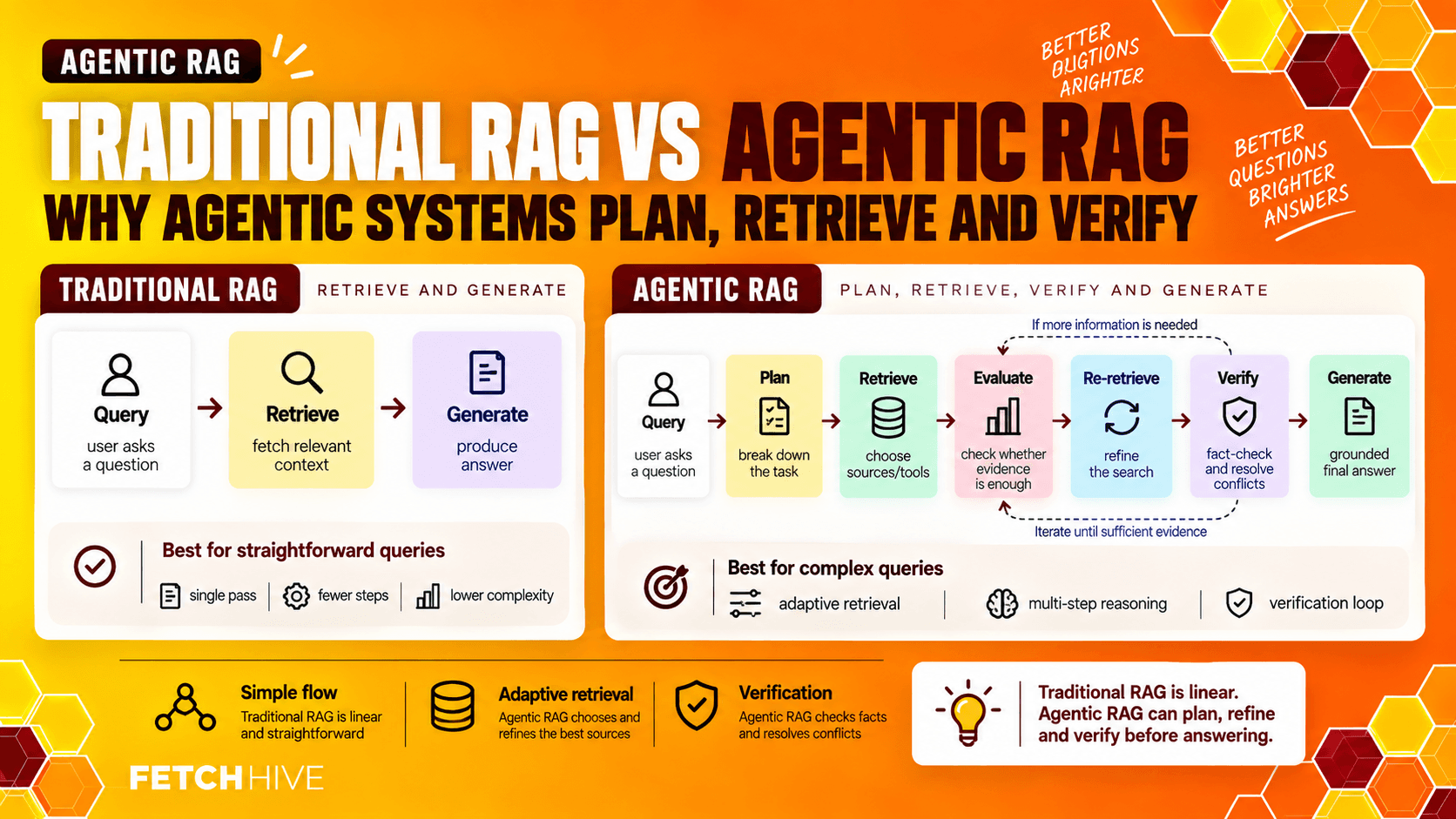
Retrieval augmented generation (RAG) solves a simple problem: large language models (LLMs) are trained on static training data, while your business runs on information that changes constantly.
A normal RAG pipeline gives a model access to external data at query time. The user asks a question, the system searches a vector database or another retrieval layer, retrieves relevant chunks, places those chunks into the prompt, and the model generates a grounded response.
If you want the full foundation first, my RAG explained guide covers the basic retrieval augmented generation RAG flow without the agent layer.
Traditional RAG works extremely well when:
the question maps neatly to one knowledge base,
the documents are reasonably clean,
one retrieval pass is normally enough,
and answering questions does not require tools or follow-up decisions.
The problem appears when retrieval itself becomes part of the reasoning.
AI agents are AI systems that can inspect a goal, choose appropriate tools, maintain working state, and perform tasks over multiple steps. A RAG agent applies those planning capabilities specifically to information retrieval and response generation.
Instead of:
Query → Retrieve → Generate |
You get something closer to:
Query → Plan → Retrieve → Evaluate → Retrieve again if needed → Refine context → Verify → Generate |
That extra loop is the whole game.
Consider this user query:
“Can a contractor based in Germany work fully remote under our current company policy?”
Traditional RAG might retrieve a German remote-work document and a company policy page, then ask the model to synthesize them.
An agentic RAG system can handle the question more carefully:
identify that internal policy and regional rules are separate data sources,
retrieve the current policy rather than an older version,
search for contractor-specific exceptions,
compare effective dates,
detect conflicting retrieved documents,
query an external database if internal information is incomplete,
and ask for clarification if the answer genuinely depends on missing information.
Unlike traditional RAG, the model is no longer just consuming context. The agent is deciding how to obtain the context in the first place.
How Agentic RAG Systems Work End-to-End
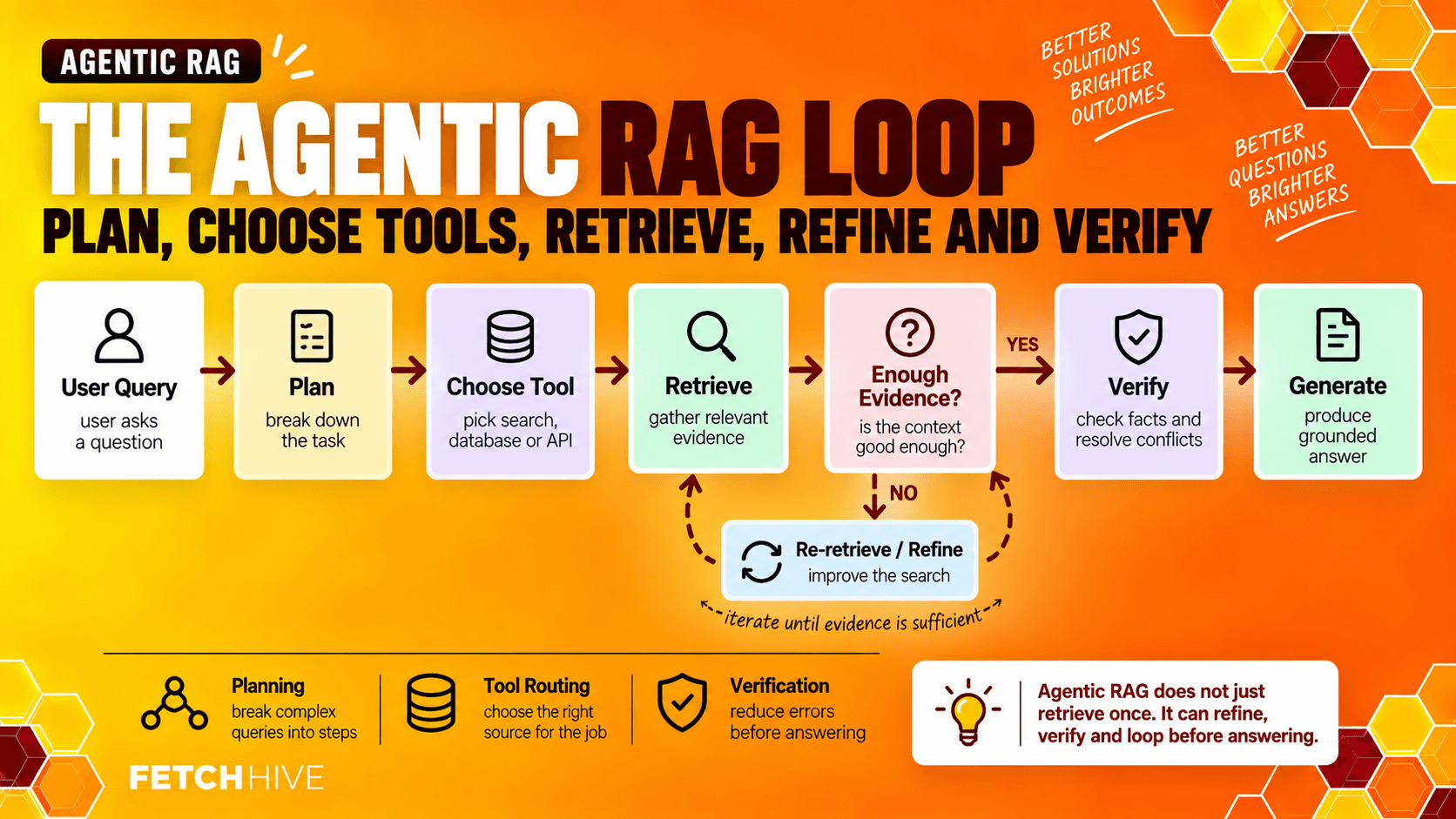
The easiest way to understand agentic RAG systems is to follow one query through the process.
Imagine a legal analyst asks:
“What changed in our remote-work policy in 2026, and how does it affect contractors in the EU?”
A decent agentic RAG workflow might look like this.
1. Understand and plan the query
The planner sees that this is not one question. It contains several tasks:
find the old and current remote-work policies,
identify what changed,
retrieve contractor definitions,
find EU-specific rules,
compare dates and jurisdictions,
then produce a final answer supported by evidence.
This is where agentic reasoning is useful. The system turns a vague natural-language query into a structured plan rather than firing one giant search and hoping for the best.
2. Choose retrieval strategies
Different questions need different retrieval methods.
The internal policy might be best handled with semantic search or vector search. A known policy ID may need keyword search. Contractor records could live in structured data queried through SQL. Regional rules may come from external databases or real time data sources.
The agent chooses the appropriate tools for each sub-task instead of forcing everything through one vector database.
That matters because a vector database is only one part of the RAG pipeline. If you treat every retrieval problem as “more vector search,” exact identifiers, filters, permissions, dates, and relationships eventually come back to bite you.
3. Retrieve and inspect the results
The system retrieves documents, records, or API results, but it does not automatically assume the first results are correct.
It can ask:
Did we retrieve the right policy version?
Are these documents current?
Did semantic search miss an exact phrase?
Is the retrieved context enough to answer every part of the query?
Did access controls remove something the user is not allowed to see?
If the answer is no, it searches again.
This is one of the biggest differences between traditional RAG and agentic RAG: retrieval becomes iterative.
4. Augment and refine context
Raw retrieved data is rarely the context you actually want to dump into a large language model.
The system may need to:
remove irrelevant information,
merge duplicate passages,
re-rank the most relevant documents,
filter outdated versions,
preserve citations and metadata,
and condense the retrieved context to fit the model’s context window.
This is still normal RAG work. Agentic RAG does not magically make chunking, embeddings, ranking, or metadata unimportant. In fact, bad retrieval underneath an agent just gives you a more expensive way to retrieve bad information.
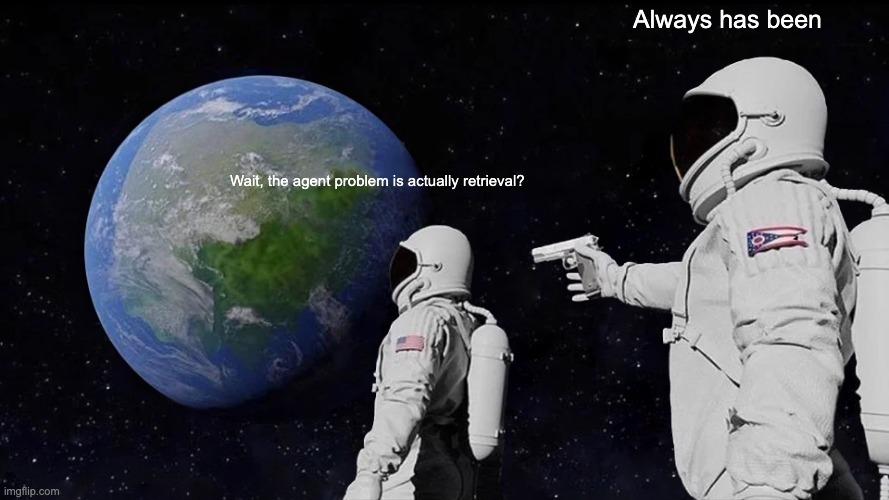
If retrieval quality is weak, fix that first. My RAG performance guide goes much deeper into chunking, ranking, hybrid search, evaluation, and the other boring-but-important bits.
5. Verify before answering
Verification is where agentic RAG earns its keep on complex queries.
The system can compare sources, check dates, inspect metadata, look for contradictions, and decide whether it needs another retrieval step before producing the answer.
This can reduce hallucinations because the model is not forced to make the best of incomplete context. In other words, better verification reduces hallucinations by giving the system somewhere to go when evidence is weak: go and get better evidence. That can lead to improved accuracy without pretending the model itself suddenly became more knowledgeable.
6. Generate the response, and optionally act
Once the system has enough evidence, response generation works much like standard RAG. The LLM receives the right context, the user query, system instructions, and any required citations or output structure.
Depending on the application, the agent may then perform actions such as:
opening a support ticket,
generating a compliance task,
updating a CRM record,
writing a report,
or handing the result to other agents.
That last part is optional. Agentic RAG is still useful even when the only final action is a grounded answer.
Key Agent Roles in Agentic RAG
People hear “multi-agent” and immediately start drawing diagrams containing seventeen boxes. You usually do not need seventeen boxes.
The useful part is separating responsibilities, even if those responsibilities all live inside one agent.
Routing agent
A routing agent decides what kind of request it is dealing with and where it should go.
For example:
FAQ question → documentation search
account question → customer database
analytics question → SQL tool
current event → web or external API
policy question → internal knowledge base plus policy metadata
Good routing protects both retrieval quality and security because the system can apply the correct data sources and access controls for each user query.
Query planning agent
The planner breaks complex queries into sub-questions and sequences them.
A question like “What is our travel cap, who can approve an exception, and did the rule change this year?” might become three separate retrieval tasks rather than one messy query.
This is where planning capabilities prevent the system from trying to solve everything in a single pass.
Retrieval agent
The retrieval agent decides how to retrieve information for each task. It might use:
semantic search,
vector search,
keyword or BM25 search,
SQL,
APIs,
web search,
knowledge graphs,
or external databases.
The goal is accurate retrieval, not loyalty to one retrieval technology.
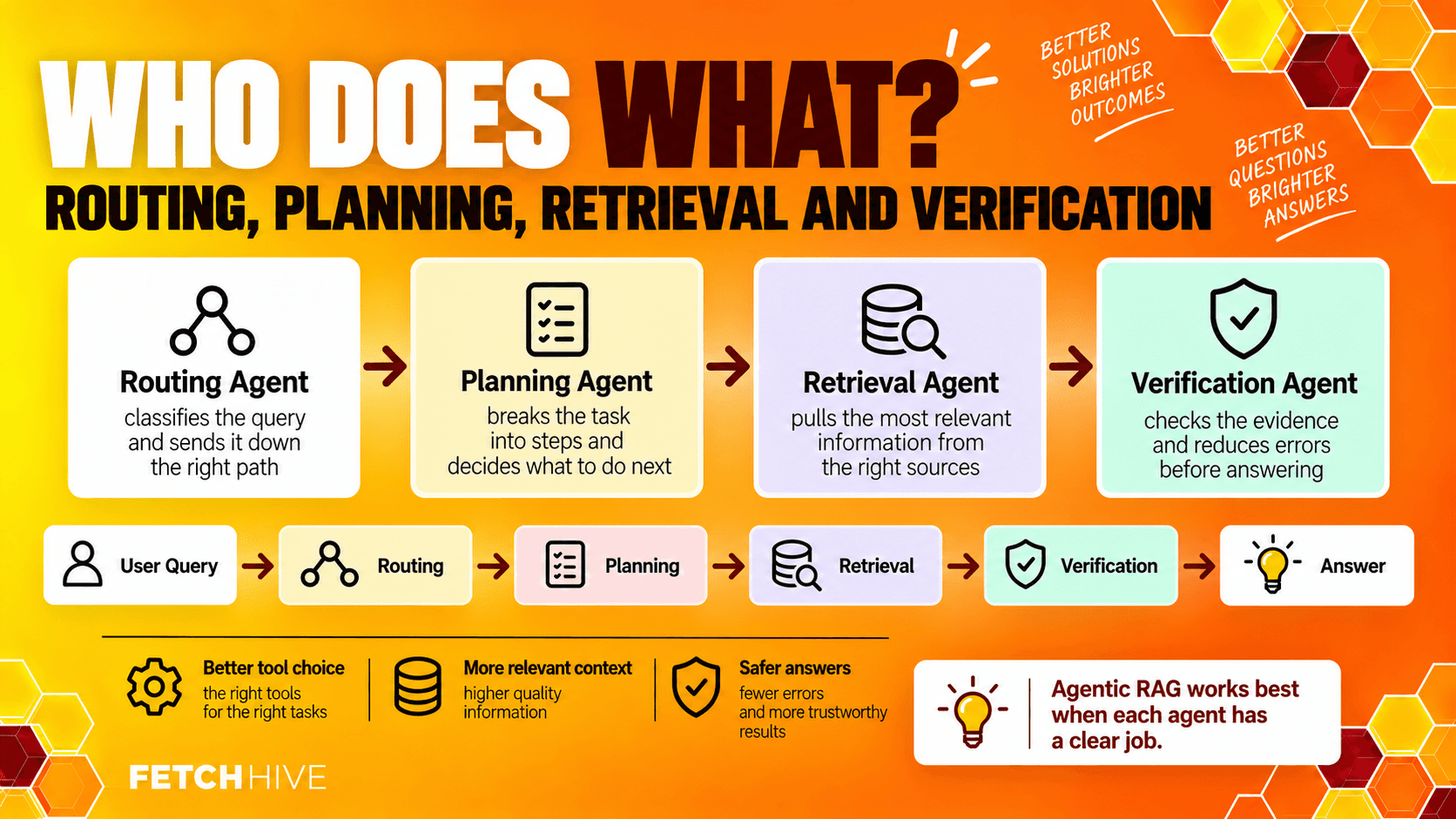
Verification agent
The verifier checks whether the retrieved information supports the proposed answer.
It can compare retrieved documents, flag conflicting facts, check dates, enforce citation requirements, and send the task back for another search when the evidence is weak.
Whether these are specialized agents or simply stages inside one agent is an architecture decision. You can connect agents when domain boundaries genuinely justify it, but do not create more autonomous AI agents just because “multi-agent” sounds impressive in a diagram.
Agentic RAG Architectures: Single-Agent vs Multi-Agent
There is no prize for having the most agents.
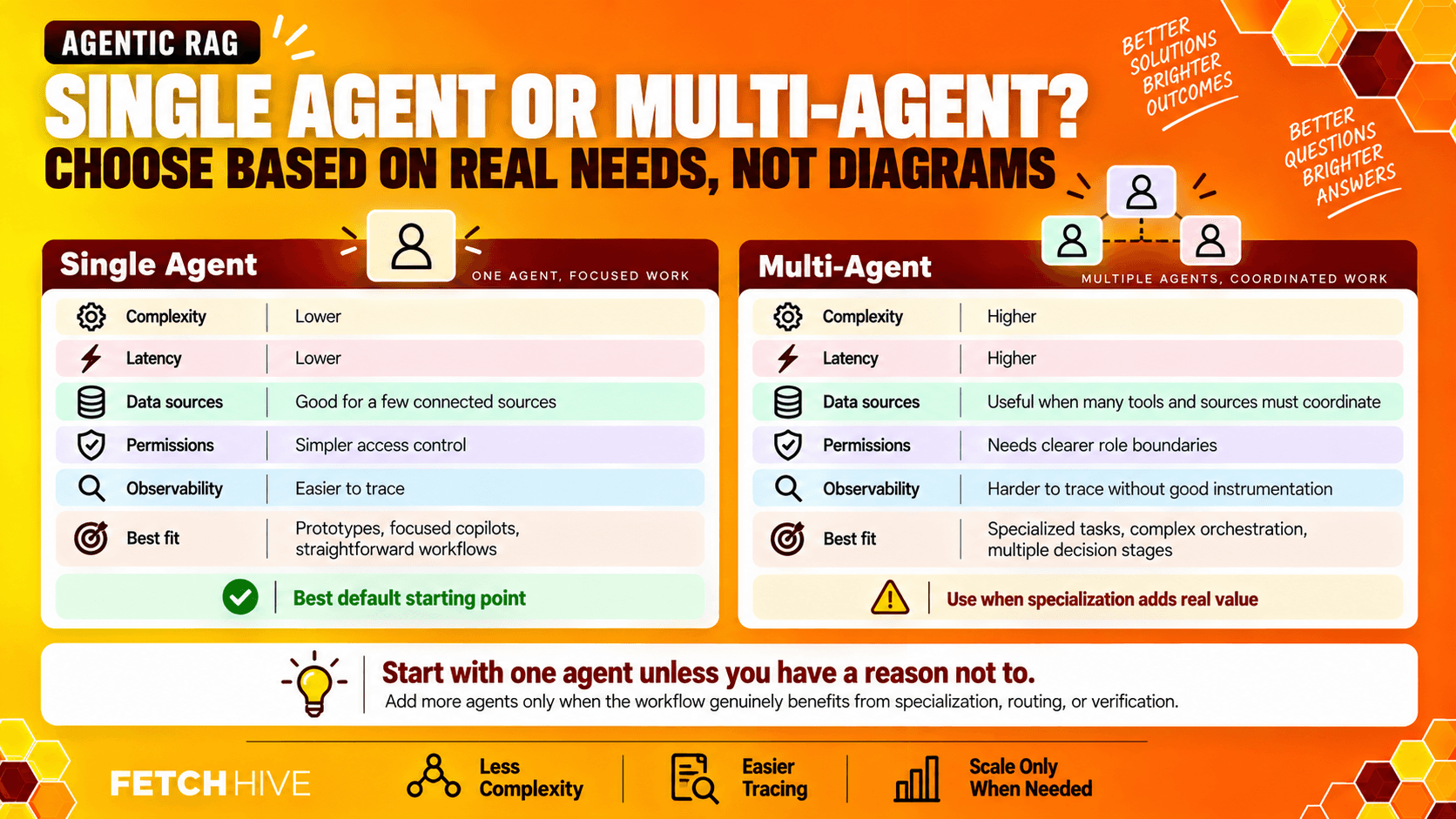
A lot of agentic RAG architectures should start with one agent that can plan, retrieve, evaluate, and verify. It is simpler to debug, usually faster, and gives you fewer failure modes.
Single-agent RAG
A single-agent setup works well when:
the number of data sources is limited,
the workflow is reasonably focused,
latency matters,
tools share similar permissions,
and one agent can comfortably handle the decision making.
For example, an internal HR assistant might query a policy knowledge base, employee database, and a small number of internal APIs. You probably do not need a separate AI agent for every source.
Multi-agent RAG
Multi-agent RAG systems start to make more sense when different domains genuinely need different tools, context, permissions, or expertise.
A customer escalation might involve:
a support RAG agent retrieving past tickets,
a product agent checking documentation and known issues,
a data agent querying account or usage data,
and a supervisor coordinating the other agents.
In that case, specialized agents provide a clean boundary between data types and responsibilities.
Common agentic RAG architectures include:
Planner-executor: one planner creates the task sequence and sends work to worker agents.
Supervisor or hierarchical model: a top-level agent coordinates several domain agents.
Tool graph: the agent chooses a route through tools based on intermediate results.
The trade-off is predictable: more agents mean more coverage, but also more latency, more tool calls, more state, more observability requirements, and more weird edge cases.
If your agent needs a project manager to coordinate the agents coordinating the RAG agents, you may have gone a little far.
Planning, Retrieval, Augmentation and Verification in Detail
The architecture gets easier to reason about when you treat these as four separate capabilities.
Planning: turn the query into work
Planning converts ambiguous user queries into explicit tasks.
For:
“Summarize our current remote-work rules and highlight EU contractor exceptions.”
The plan might be:
1. retrieve current internal policy,
2. find prior policy for comparison,
3. retrieve contractor definitions,
4. retrieve regional exceptions,
5. reconcile dates and conflicts,
6. generate the answer with citations.
The planner can also select tools. SQL for structured data. Vector search for policy text. APIs for external data. Keyword search for exact policy codes.
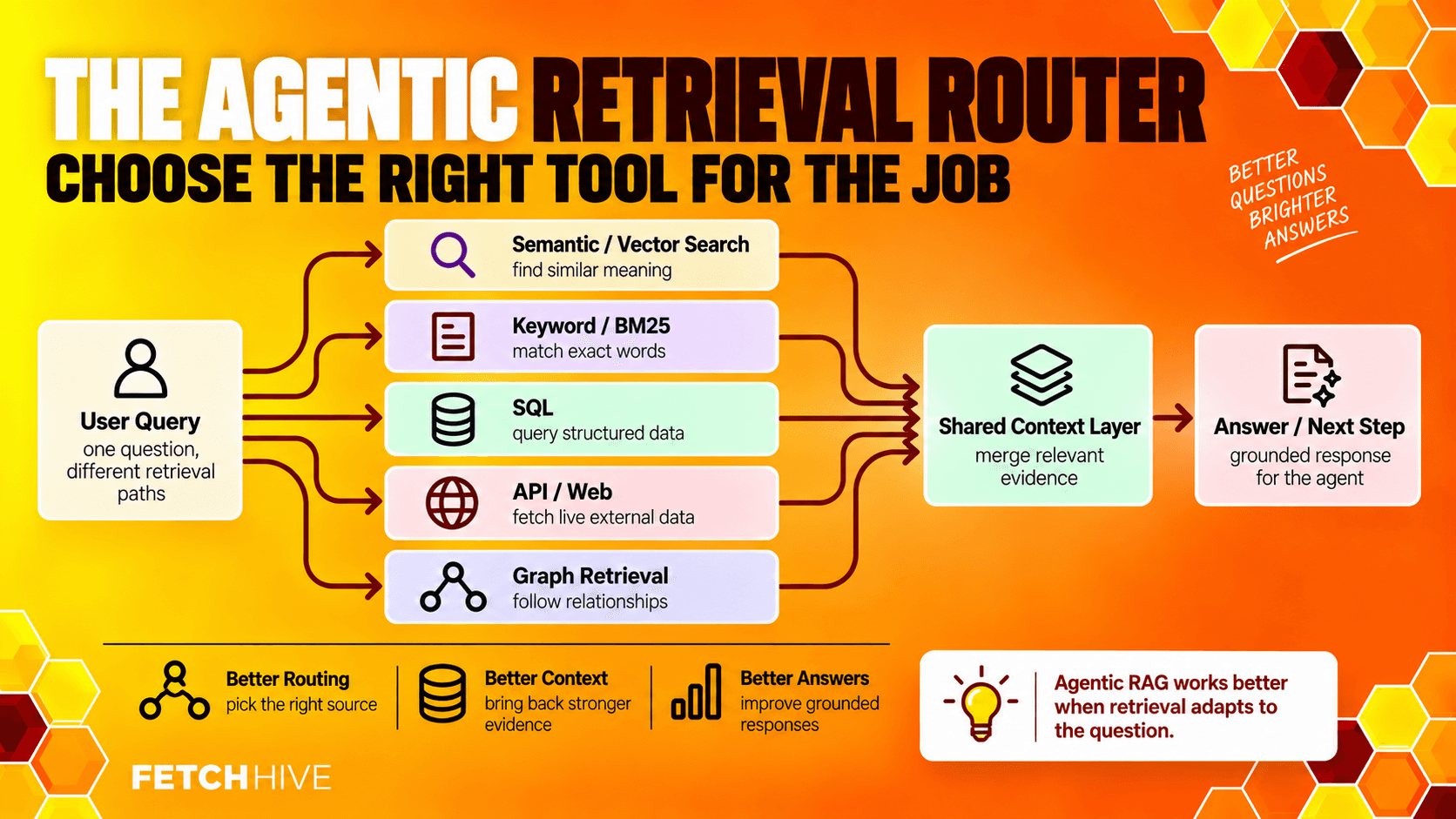
Retrieval: use the right tool for the job
Retrieval is where many RAG systems get needlessly dogmatic.
Semantic search is excellent for matching meaning. Keyword search is excellent for exact strings. SQL is excellent for structured data. APIs are excellent for current data. Graph retrieval can be useful when relationships are the point.
Agentic RAG lets the system combine those retrieval strategies instead of pretending one method handles every query equally well.
That is also why RAG embeddings and vector databases still matter. Agentic retrieval sits on top of the retrieval layer. It does not replace it.
Augmentation: give the model useful context, not a data dump
Once information is retrieved, it still needs cleaning.
The system should remove duplicate or irrelevant information, preserve useful metadata, prioritize the most relevant documents, and make sure the model receives the right context rather than the largest possible context.
More retrieved data does not automatically mean a better answer. Sometimes it just means you have made the model read more rubbish before being wrong.
Verification: check that the evidence is good enough
Verification asks whether the current evidence actually supports the answer.
Useful checks include:
source agreement,
citation coverage,
effective dates,
permission metadata,
missing sub-questions,
contradictory documents,
and whether the answer contains claims not supported by retrieved context.
If the evidence is weak, the verifier can trigger another query, ask for clarification, or refuse to invent an answer.
That final option is underrated.
Enterprise Use Cases for Agentic RAG
Agentic RAG systems are most useful when a request crosses multiple data sources, requires current information, or needs the system to make decisions during retrieval.
If you just need seven broader examples of where RAG fits, I already covered those in 7 RAG use cases. The examples below are specifically where the agentic layer adds something useful.
Policy, legal and compliance Q&A
Policy questions are rarely as simple as “find the paragraph containing this phrase.”
You may have regional rules, old and current versions, internal policies, external regulations, exceptions, and documents with different effective dates.
A RAG agent can retrieve information from several sources, compare them, detect missing evidence, and produce an answer that explains which source applies.
Customer support and operations
A support agent might need to combine help-centre content, previous tickets, product logs, customer account data, and current incident status.
Traditional RAG can retrieve the documentation. Agentic RAG can decide when documentation is not enough, call the relevant systems, then turn the result into actionable insights or a follow-up task.
Knowledge management and enterprise search
Large companies rarely have “the knowledge base.” They have twelve of them, three wikis nobody admits ownership of, Slack, Google Drive, SharePoint, internal databases, and one terrifying spreadsheet that apparently runs finance.
Agentic RAG can plan searches across those systems, refine queries, and combine relevant information from different repositories instead of treating enterprise data as one neat corpus.
Analytics and reporting
A user asks a natural-language question. The agent turns part of it into SQL, retrieves the numbers, compares them with another source, then explains the result.
This is useful for complex tasks where generated commentary and structured data need to agree, and where users actually want real time insights rather than a stale dashboard summary.
Software development
Engineering questions often span source code, documentation, issue trackers, API specs, logs, and external libraries.
Agentic RAG can route sub-questions to the right tools and data sources, then combine the results into one response. Multimodal models can extend this further when the relevant context includes screenshots, diagrams, or other non-text inputs.
Designing and Implementing an Agentic RAG System
The easiest way to build a terrible agentic RAG system is to start with the agents.
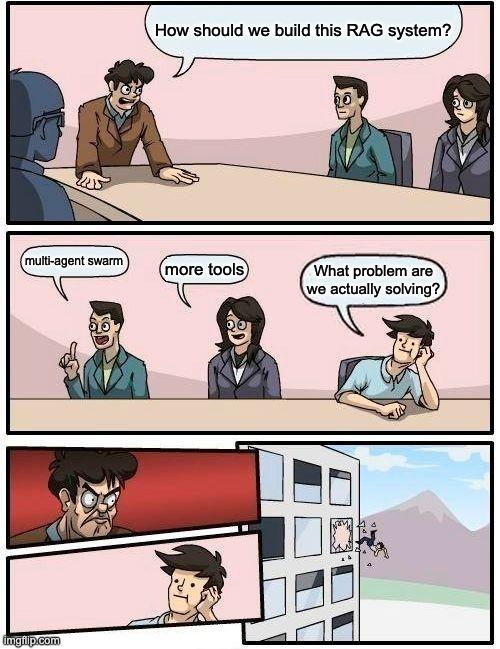
Start with the problem.
You need a clear use case, representative data, reliable retrieval, sensible permissions, and a way to evaluate whether the system is actually better than a simpler traditional RAG approach.
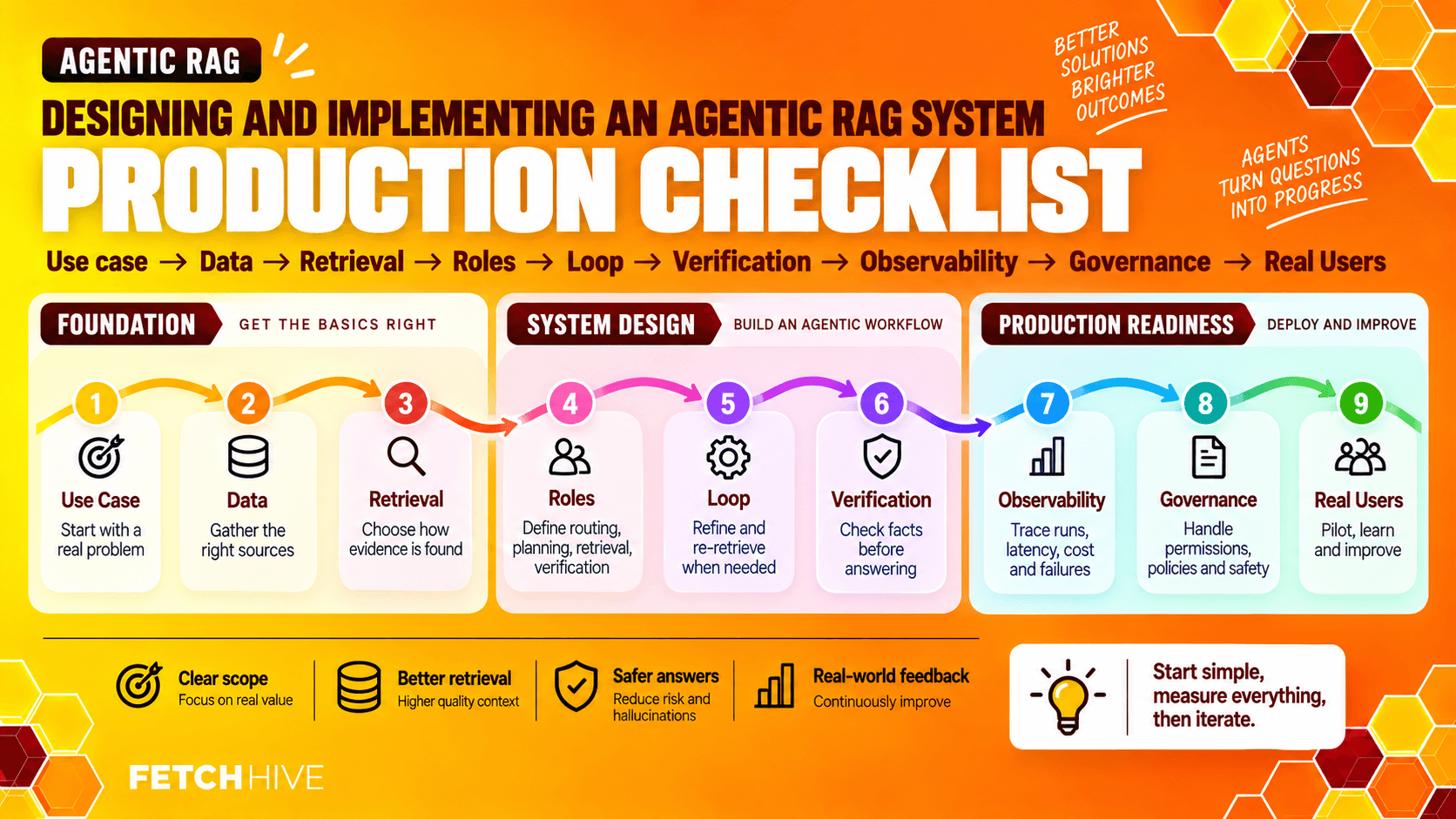
A practical implementation path looks like this:
1. Choose one focused use case. Pick a workflow where multi step reasoning or multiple data sources are genuinely required.
2. Inventory the data sources. Identify structured data, unstructured enterprise data, APIs, external databases, and real time data the system needs.
3. Fix the retrieval layer. Get chunking, semantic chunking, embeddings, metadata, keyword search, vector databases, and ranking into decent shape before adding agent loops.
4. Define the agent roles. Decide whether you need a routing agent, planner, retriever, verifier, or whether one agent can perform all four roles.
5. Build the retrieval loop. Plan, retrieve, evaluate sufficiency, refine context, and re-retrieve when necessary.
6. Add verification. Make source checks, citations, dates, and contradiction handling explicit rather than hoping the model does it naturally.
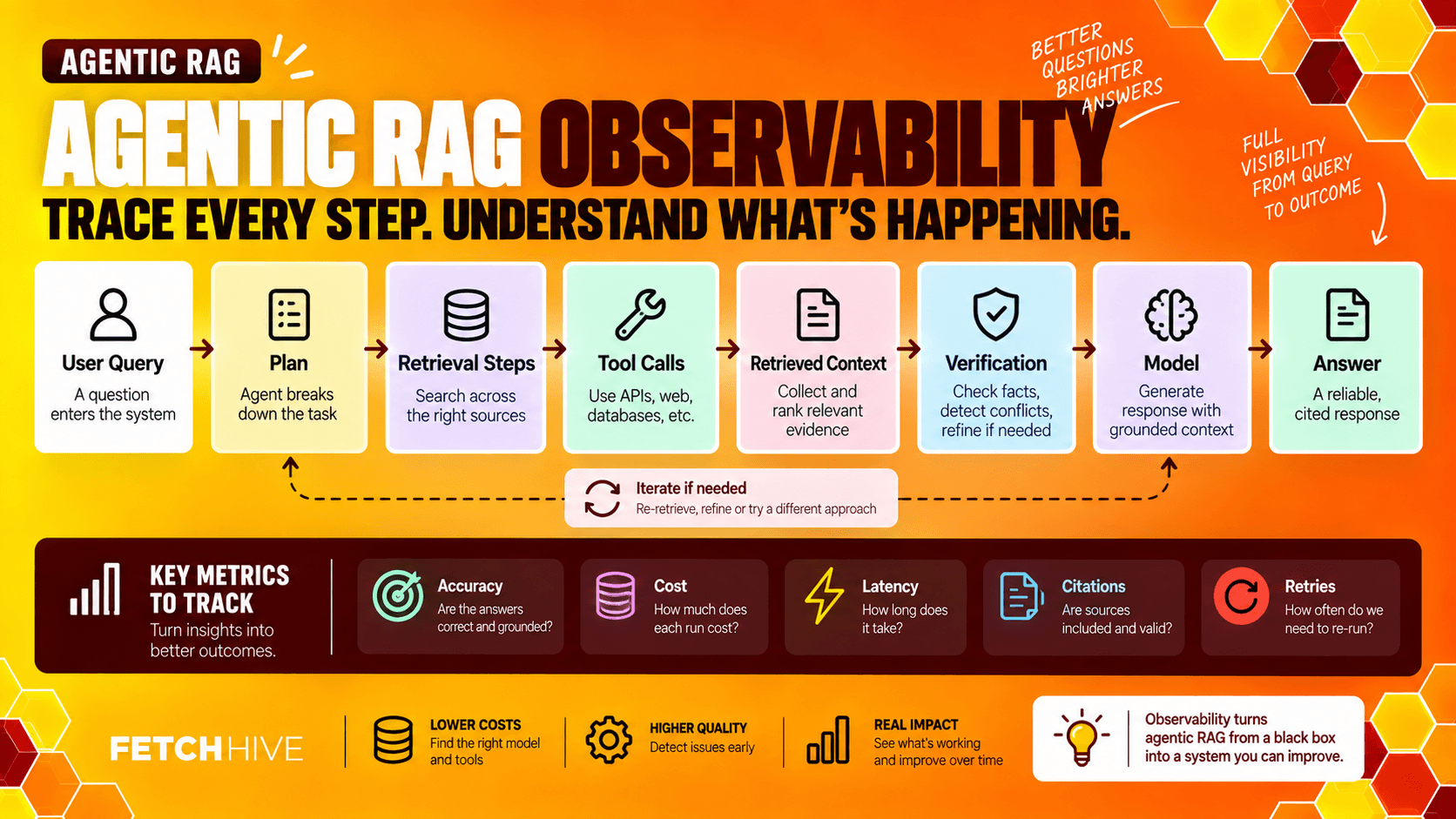
7. Add observability. Log retrieval steps, model calls, tool usage, failures, cost, latency, and the final response.
8. Apply governance. Enforce access controls, data redaction, and human review where the risk warrants it.
9. Pilot with real users. Collect feedback and inspect failures instead of judging the system from five hand-picked demo queries.
The observability bit matters more than people think. When an agent gives a bad answer, you need to know whether the problem came from the query plan, retrieval, a tool call, the retrieved context, verification, or the final model.
This is also why I care about tracing in Fetch Hive. I want to see the plan, tool calls, retrieved context, model calls, cost, and failures rather than staring at the final answer and guessing which part went wrong.
Best Practices and Limitations of Agentic RAG
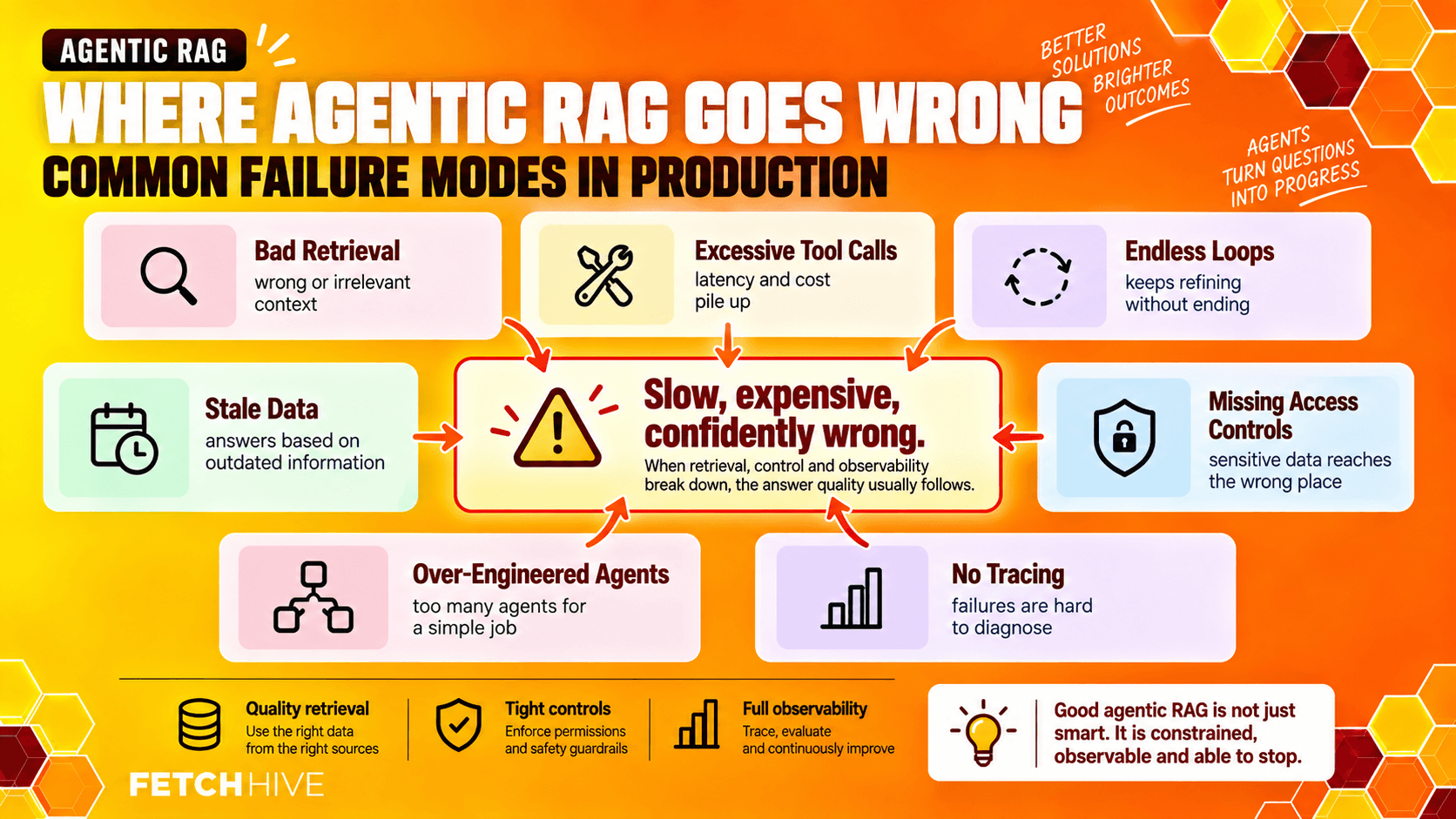
Agentic RAG gives you more flexibility. Unfortunately, flexibility is also another word for “more ways for things to go wrong.”
Do more of this
Start narrow. Pick a high-value workflow and prove it works before letting agents loose across the entire company.
Limit tools. Every tool expands what the agent can do, but also increases decision complexity, security surface, and the chance of a pointless detour.
Get retrieval right first. Bad chunking, weak embeddings, poor metadata, or irrelevant search results will not be rescued by agentic reasoning.
Keep data management boring and disciplined. Versioning, freshness, permissions, metadata, and source ownership are not glamorous. They are also the difference between retrieving the current policy and confidently quoting one from 2023.
Use feedback. Thumbs up/down, corrections, failed searches, and task outcomes give you a much better picture than “the demo looked good.”
Avoid this
Endless agent loops. More tool calls can improve coverage, but at some point you are just paying an AI system to procrastinate.
Over-engineered multi-agent systems. If one agent can do the job, use one agent.
Relying solely on automated verification. High-risk legal, financial, security, or compliance decisions may still need a human in the loop.
Ignoring latency and cost. A traditional RAG request might use one retrieval call and one model call. An agentic workflow can use many of each. That adds up quickly.
Assuming “agentic” means accurate. It does not. Agentic RAG can improve accuracy by retrieving better evidence and checking it, but a bad plan can also send the system confidently down the wrong path.
What Should You Measure?
If you cannot see what your RAG agents are doing, optimization becomes guesswork.
At minimum, track:
answer accuracy,
retrieval success,
citation coverage,
number of retrieval steps,
average tool calls per query,
re-retrieval rate,
latency,
cost,
user feedback,
and the point at which failures occur.
I would also separate retrieval failures from reasoning failures. If the right document never made it into the context, changing the final prompt is probably not your fix.
The same principle applies to agentic RAG as every other RAG system: diagnose the layer that is actually failing before changing everything at once.
Agentic RAG Is Useful When Retrieval Needs to Think
Agentic RAG is not a replacement for traditional RAG.
It is what you reach for when the retrieval process itself needs planning, tool selection, iteration, and verification.
For simple questions against one clean knowledge base, traditional RAG is usually faster, cheaper, and easier to maintain. Use it.
When user queries span multiple data sources, require up to date knowledge, depend on current data, or need the system to handle complex decisions before answering, agentic RAG systems become much more interesting.
The sensible progression is:
Get RAG working → get retrieval accurate → add agentic behaviour where it solves a real problem → trace everything → scale only when the evidence says you should. |
You do not need a swarm of autonomous AI agents to call your system agentic. You need a retrieval process that can make useful decisions, recognize when it lacks the right context, and go get better information before it answers.
That is the part worth building.
Share this post


