RAG vs Fine-Tuning: Which Should You Use?

By
Tom Dallimore
Published

RAG vs fine tuning gets framed like an architecture cage match far more often than it should. Pick a side. Defend it on LinkedIn. Rebuild the entire system six months later when the problem changes.
In practice, retrieval augmented generation and fine tuning solve different problems. RAG changes the information a model can see at query time. Fine tuning changes how the model itself behaves by adjusting its internal weights during a training process.
That distinction clears up most of the confusion. If your AI needs fresh facts, internal documents, citations or real time data retrieval, RAG is usually the better starting point. If it needs a consistent output format, domain specific behavior or better performance on a narrow task, fine tuning starts to make more sense. And if you need current facts plus specialized behavior, both RAG and fine tuning can live in the same system perfectly happily.
So this is not really a question of which technique is "better". It is a question of what you are trying to change: the context going into the model, or the model itself.
RAG vs Fine Tuning: The Short Answer
If you only remember one thing from this article, make it this: RAG is mainly a knowledge-access problem. Fine tuning is mainly a behavior-and-specialization problem.
Choose RAG when knowledge changes regularly, relevant information lives across external data sources, or users need citations back to the source.
Choose fine tuning when you want a model to behave consistently on specific tasks, follow a strict output format, learn domain language or perform a narrow job very well.
Use both when the model needs domain expertise and up to date information at the same time.
A support assistant is a simple example. If the problem is that it does not know yesterday's pricing change, fine tuning the model is a very expensive way to solve the wrong problem. Give it retrieval. If it knows the facts but keeps returning the wrong schema, tone or classification style, adding another vector database will not magically fix that either.
The RAG vs fine tuning decision becomes much easier once you stop treating both approaches as substitutes for everything.
What RAG Actually Changes
Retrieval augmented generation (RAG) connects large language models to external data at the moment a user's query arrives. Instead of asking the model to rely only on the model's pre trained knowledge, a retrieval system searches a knowledge base, finds relevant data, and adds that retrieved data to the prompt before generation.
That knowledge base can contain internal documents, product manuals, tickets, policies, database records, APIs, unstructured data or pretty much any source you can sensibly retrieve from. The model itself can stay unchanged while the information around it moves constantly.
This is why a RAG model is useful for things like policy Q&A, support, internal search and operational assistants. Update the source material, re-index where necessary, and the next answer can use the new data. You do not have to retrain the language model because somebody changed a refund policy on Tuesday afternoon.
If you want the broader foundation first, our RAG explained guide covers the concept from the ground up, while the RAG architecture and RAG pipeline guides go much deeper into how the pieces fit together in production.
How does RAG work in practice?

The simplified flow looks like this:
The user's query enters the system.
The retrieval system searches vector databases, keyword indexes, SQL, APIs or another relevant source.
The most relevant information is selected, filtered and added to the prompt.
The large language model generates an answer using the retrieved context.
There is obviously more going on in a serious RAG architecture - chunking, embeddings, reranking, metadata filters, permissions, evaluation and monitoring - but the core job is still retrieval. Get the right context in front of the model at the right time.
This is also why RAG performance can fall apart even when the base model is excellent. If retrieval returns the wrong policy, stale data or five vaguely related chunks, the model now has excellent instructions for confidently using bad evidence. Lovely.
Where RAG shines
RAG systems are usually a strong fit when your information is large, dynamic or needs to remain auditable.
Fresh knowledge: product docs, regulations, pricing, policies and operational data can stay up to date without changing model weights.
Traceability: retrieved documents can be surfaced as citations, making it easier to check where an answer came from.
Large corpora: you can search large sets of internal documents without baking all of that domain knowledge into the model.
Access control: relevant data can remain in governed stores, with retrieval deciding what each user is allowed to see.
Fast iteration: data engineers can update data pipelines, indexes and source content without starting another model training cycle.
Where RAG bites back
RAG is not a magic "connect my docs" button. You are adding a retrieval layer, and that layer becomes part of the product.
Data quality matters enormously. Duplicate documents, bad chunking, stale versions, missing metadata and sloppy permissions all leak into the answer. If the underlying source is rubbish, your shiny AI system is now simply very good at finding rubbish faster.
You also take on operational work: ingestion, embeddings, vector databases, retrieval evaluation, latency, access controls and monitoring. RAG can be cheaper than repeated training for knowledge-heavy use cases, but it is not free infrastructure.

What Fine Tuning Actually Changes
Fine tuning starts from a base model or pre trained language model and continues training it on examples that represent the behavior you want. The fine tuning process adjusts model parameters so those patterns become part of the model's internal weights.
That is fundamentally different from RAG. You are not giving the model a document to read at runtime. You are changing the model itself.
The fine tuning aim might be a consistent tone, a strict JSON schema, better classification, domain specific tasks, specialized terminology or a narrow reasoning pattern. Good training examples teach the model what a strong output looks like again and again until that behavior becomes much more reliable.
One useful fine tuning understanding to keep in your head: training is not a database update. Fine tuning represents a change in behavior encoded in the weights. It can improve how the model handles a task, but it is a terrible replacement for a source of truth that changes every week.
How fine tuning a model works
A typical training process looks something like this:
Start with a base model that already has broad language capability.
Prepare high-quality training data made from realistic prompts and labeled examples.
Run training so the model weights move toward the desired responses.
Evaluate model performance on held-out examples rather than congratulating yourself because the training set looks good.
Repeat until the model is genuinely better at the target job.

Traditional fine tuning can update a large number of parameters, which is expensive. Parameter efficient fine tuning techniques such as LoRA and QLoRA update a much smaller set of parameters or adapters, reducing training costs and computational resources while still giving teams a useful way to specialize AI models.
Making fine tuning worthwhile still depends on the dataset. A thousand mediocre examples do not become domain expertise because you rented a GPU. Fine tuning projects live or die on the quality and representativeness of the training data.
Where fine tuning shines
Fine tuning works best when the behavior you want is reasonably stable and repeatable.
Consistent output format: structured JSON, classifications, legal document analysis, claim summaries or other outputs where shape matters.
Domain specific knowledge and language patterns: terminology, jargon and reasoning conventions that generic models handle inconsistently.
Specialized tasks: high-volume jobs where a fine tuned small model can outperform a larger general model at lower inference cost.
Tone and style: behavior that would otherwise require huge prompts or repeated prompt engineering.
Offline or constrained environments: cases where live external data sources or retrieval infrastructure are unavailable.
This is where fine tuning shines: not because it magically gives the model every fact your company has ever produced, but because it can make a narrow behavior much more predictable.
Where fine tuning gets expensive
The obvious cost is training. Extensive fine tuning on large AI models can require serious computational resources, experimentation and evaluation. Even when the training costs are manageable, somebody still has to build the dataset, clean it, version it, run experiments and prove the new model is actually better.
Then there is staleness. If you have a model fine tuned on a policy set from last year and the policy changes tomorrow, the model does not wake up with the new information. You need new training data and another fine tuning cycle, or a retrieval layer that supplies current facts.
Limited training data creates another problem. Fine tuning can amplify bad patterns just as easily as good ones. If the labeled examples are noisy, biased or not representative of real usage, you can end up spending money to make the model consistently wrong.

RAG vs Fine Tuning: The Key Differences That Matter
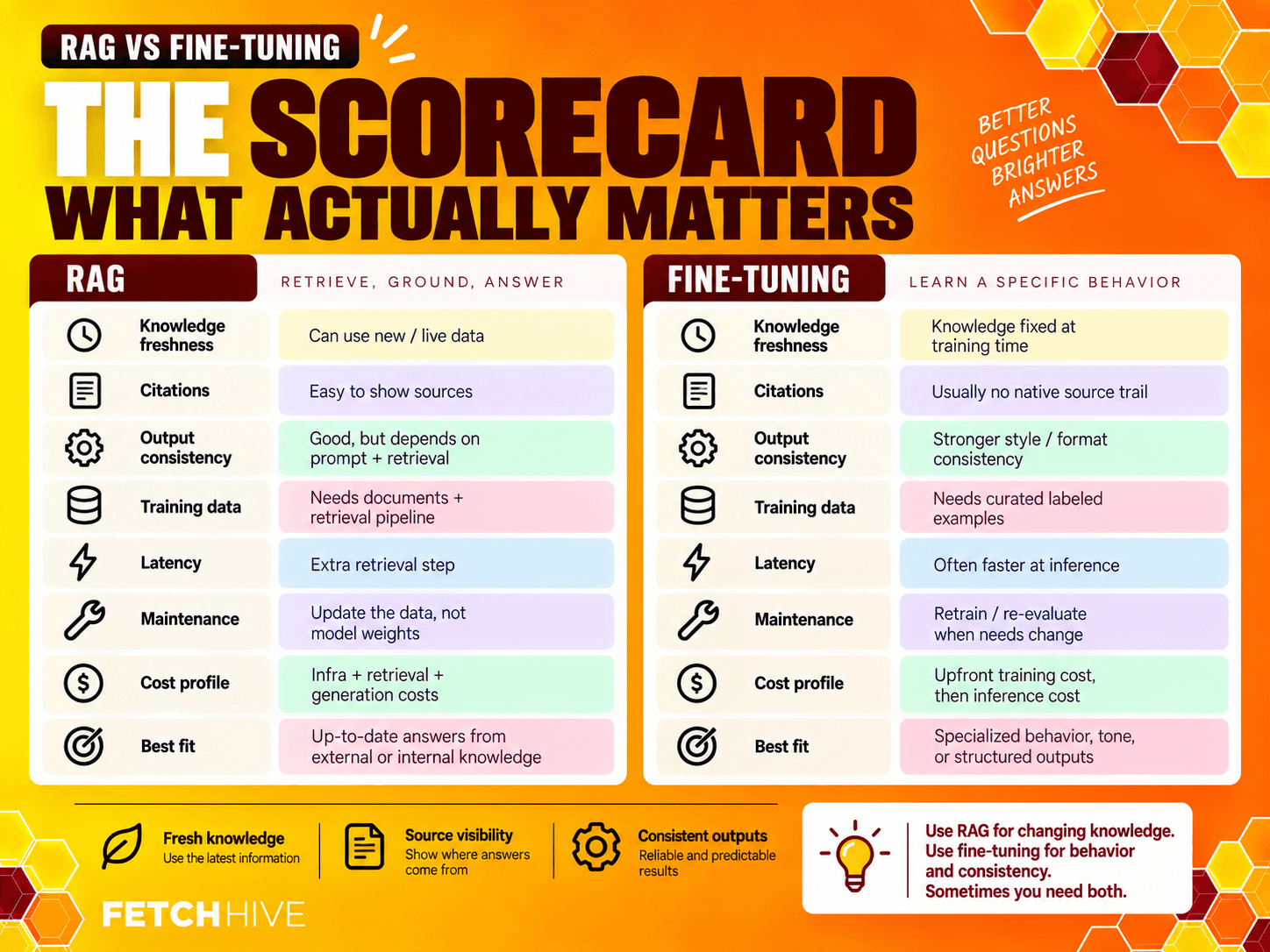
The cleanest way to compare RAG and fine tuning is to look at what each approach changes in production.
Dimension | RAG | Fine Tuning |
What it changes | Context supplied at query time | Model behavior / weights |
Best for | Fresh facts, citations, changing knowledge | Stable behavior, style, format, narrow tasks |
Knowledge freshness | High - update sources / index | Low unless you retrain |
Traceability | Strong - source documents can be cited | Weaker - knowledge is encoded in weights |
Training data | Not required for basic retrieval | High-quality labeled examples matter |
Serving path | Extra retrieval steps add latency | Usually simpler at inference |
Maintenance | Pipelines, indexing, retrieval quality | Datasets, training, evaluation |
Best hybrid role | Provide current evidence | Provide specialized behavior |
Neither side wins every row. That is the point. The right architecture follows the problem rather than whichever technique is getting the most conference talks this month.
Data Quality Matters More Than the Architecture Debate
Data quality is one of the few things that can ruin both approaches equally efficiently.
For RAG, poor source data means poor retrieval. Old policies, duplicate content, broken permissions and badly structured documents produce weak context. The retrieval layer cannot invent accurate data that does not exist.
For fine tuning, poor training data means poor behavior. Bad labels, contradictory examples and unrealistic prompts become part of the training signal. A model can absolutely learn your mistakes with impressive consistency.
Enterprise AI teams therefore need boring things like source ownership, versioning, evaluation sets, audit trails and clear update processes. Boring infrastructure has an annoying habit of mattering more than the exciting demo.
When to Choose RAG
Choose RAG when the system's main problem is access to relevant, changing or governed information.
Your knowledge changes frequently and the answer needs current facts.
You have lots of internal documents or external data sources but limited training data.
Users need citations or provenance.
Different users have different permissions over the same knowledge base.
You need real time data retrieval from databases, APIs or live systems.
The relevant information is scattered across several systems and should not be duplicated into model weights.
In these cases, fine tuning a model first often creates work without solving the actual bottleneck. If the issue is knowledge freshness, fix knowledge access.
When to Choose Fine Tuning
Choose fine tuning when the information is relatively stable but the model's behavior is the problem.
You need a consistent output format across huge volumes of requests.
The task depends on specialized knowledge, terminology or domain expertise that generic language models handle poorly.
You have enough high-quality labeled examples to train and evaluate the behavior properly.
You are optimizing a narrow, repeatable job where a fine tuned small model can improve cost efficiency.
Latency matters enough that removing runtime retrieval is genuinely valuable.
Fine tuning is especially attractive when the task has a clear definition of "good". Classification, extraction, structured generation and domain-specific transformations are much easier to train than vague instructions like "be smarter about our business".
When You Should Use Both RAG and Fine Tuning

The funniest part of the RAG vs fine-tuning debate is that plenty of good production systems use both.
A fine tuned component can handle stable behavior, tone, formatting or domain reasoning. RAG supplies current facts, internal documents and relevant data at query time. One changes how the model behaves; the other changes what evidence it has available.
Take a legal assistant. Fine tuning can teach the model how to structure a legal analysis and use domain-specific language. RAG can retrieve the latest regulations, case law and client documents. The model gets specialized behavior without pretending its training cutoff is a live legal database.
You will sometimes see this described as fine tuning RAG, but I find it clearer to separate the responsibilities. Fine tuning handles stable behavior. Retrieval handles changing knowledge. Both RAG and fine tuning then have a reason to exist instead of being bolted together because the architecture diagram looked lonely.
Hybrid systems do add complexity. You now own data pipelines and retrieval plus a model training process. But for high-stakes enterprise AI, that extra work can be justified when you genuinely need both freshness and specialization.
Who Actually Owns This in a Team?
RAG vs fine tuning is not purely an ML decision. Deliver AI systems well and you quickly discover that several teams own different parts of the result.
Data engineers own ingestion, data pipelines, vector databases, document quality, permissions and the flow of relevant data into retrieval. They also help prepare domain specific data for training.
ML engineers own model selection, fine tuning projects, evaluation, training runs, model parameters and experiment tracking.
Product teams and domain experts define what a correct answer actually looks like, contribute labeled examples and decide which domain expertise matters.
If one group makes the decision alone, you normally get an architecture optimized for the thing that group already likes. Data teams build retrieval. ML teams train models. Vendors recommend whatever happens to be on the invoice. A cross-functional decision is much less exciting and usually much better.
Cost, Latency and Operational Reality
The cost question is more nuanced than "RAG cheap, fine tuning expensive".
RAG usually avoids large upfront training costs, but you pay for storage, embeddings, retrieval infrastructure, model context, monitoring and ongoing maintenance. Fine tuning has a more obvious training bill, but a specialized model can be cheaper at inference if it replaces a much larger model or removes long prompts.
Latency follows a similar pattern. RAG adds runtime hops: embed the query, search, rerank, assemble context, then call the model. Fine tuned models can have a simpler serving path. But if a task needs real time data, shaving 150 milliseconds by removing retrieval is not a win if the answer is now six months out of date.
The useful cost efficiency calculation is total system cost for the quality you need. Include engineering time, training costs, retrieval infrastructure, model usage, observability and the cost of bad answers. Optimizing the cheapest individual API call while ignoring everything around it is how you end up with a very efficient system nobody trusts.
This is also why I care about tracing in Fetch Hive: if you are comparing RAG, a fine tuned component or a hybrid system, you should be able to see the retrieval steps, model calls, latency and cost instead of guessing which architecture is actually cheaper in production.
Decision Guide: RAG vs Fine Tuning vs Both
If you are still unsure, run through these questions in order.
Does the answer depend on information that changes regularly? If yes, start with RAG.
Do users need sources, citations or permissions around that information? That pushes you further toward RAG.
Is the main problem tone, structure, classification or a stable domain-specific behavior? Fine tuning becomes more attractive.
Do you actually have good training examples? If not, do not invent a fine tuning project just because it sounds advanced.
Do you need current facts and specialized behavior? Use both.
Can prompt engineering solve the behavior problem cheaply enough? Try that before committing to training.
My default for most knowledge-heavy applications would be to start with RAG, measure the failures, and only choose fine tuning when the data shows a behavior problem retrieval cannot solve.
For narrow, stable, high-volume tasks, I would happily do the opposite: start with a smaller model fine tuned for the job and add retrieval only if the task genuinely needs external knowledge.
And if both approaches look plausible, pilot them. Measure answer accuracy, retrieval quality, format compliance, latency and cost. Let the evaluation decide instead of turning the architecture meeting into a religious argument.

RAG vs Fine Tuning: Final Take
There is no universal winner here.
RAG is the better tool when the model needs access to fresh, auditable or changing information. Fine tuning is the better tool when the model needs to behave differently on a stable, well-defined task. Hybrid systems make sense when you need both.
The mistake is choosing a technology before identifying the failure you are trying to fix.
If your model is wrong because it cannot see the right document, fix retrieval. If it can see the right information but still behaves inconsistently, look at prompting, evaluation and potentially fine tuning. If both are broken, congratulations: you have found two problems instead of one.
Build the smallest system that solves the actual problem, measure it with real data, and make it more sophisticated only when the evidence gives you a reason.
Share this post