
Hybrid RAG: How Keyword and Vector Search Work Together

By
Tom Dallimore
Published
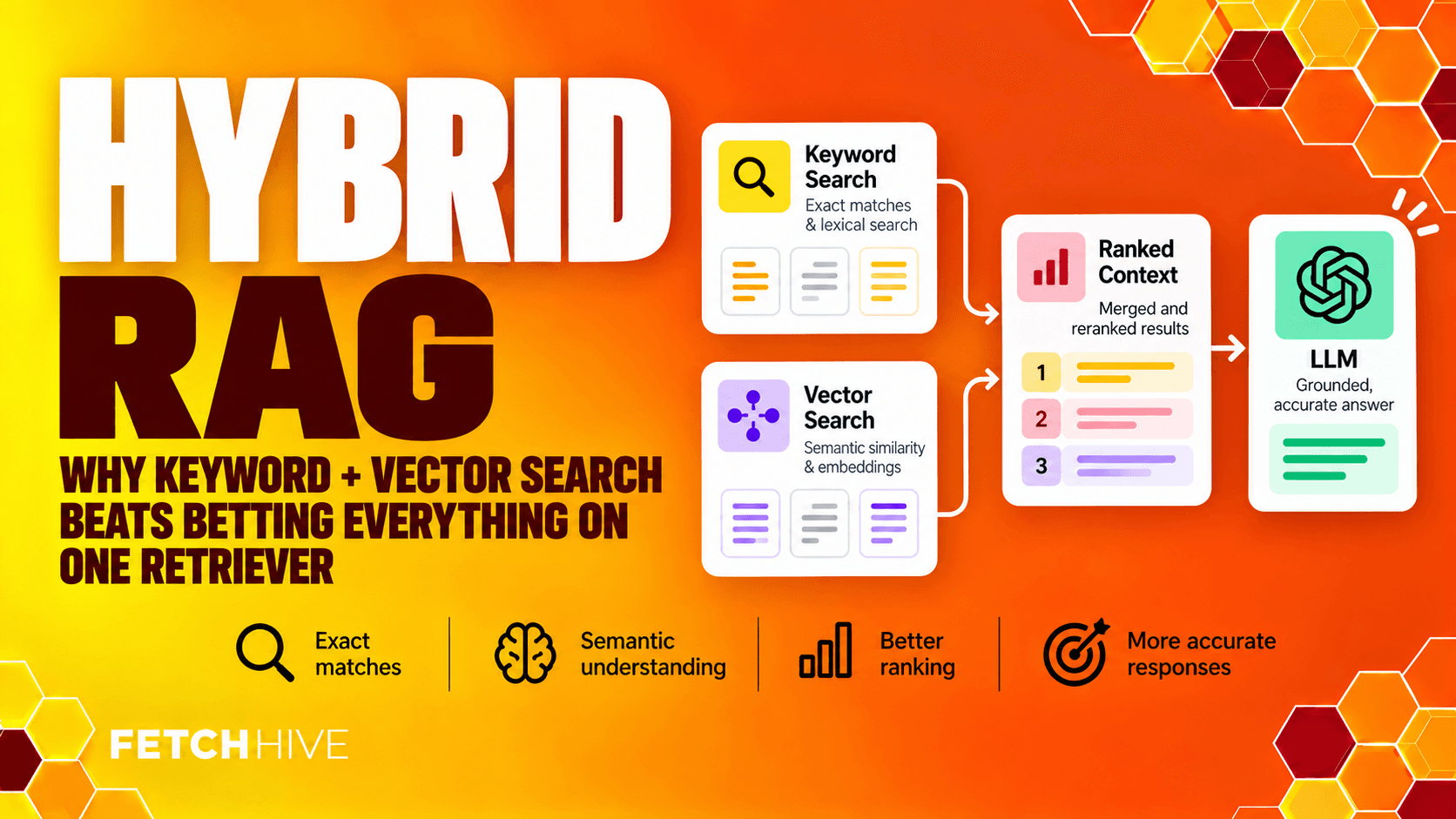
Vector search is brilliant at meaning. Keyword search is brilliant at exactness. The problem is that real users have absolutely no interest in choosing which one your RAG system should use before they ask a question.
They will search for an error code like AUTH_4017, then ask something vague like “why are customers in Europe seeing login failures?”, then paste a product name that differs from your documentation by one character. Lovely.
That is the basic argument for hybrid RAG. Instead of betting the entire retrieval process on one technique, a hybrid RAG system combines keyword search, vector search, and sometimes other retrieval methods such as filters, SQL queries, or knowledge graphs. The goal is not to make the architecture look impressive. It is to retrieve better evidence for the question that is actually being asked.
If you are completely new to retrieval augmented generation, start with my RAG explained guide. If you already understand the basic RAG system and want to know why one retriever is rarely enough, carry on.
The short version: hybrid retrieval gives you the semantic understanding of embeddings and the keyword precision of exact matching. Done well, you get more relevant documents, better factual accuracy, and a large language model that has a much better chance of producing accurate answers. Done badly, you simply build two search systems that disagree with each other and send both piles of rubbish to the model.
What Is Hybrid RAG?
Hybrid RAG is a retrieval augmented generation architecture that uses multiple retrieval methods to find context before response generation. The common version combines dense semantic retrieval with sparse keyword matching, then merges the relevant results into one ranked list before the model generates responses.
Think of it as refusing to make one retrieval mechanism responsible for every kind of query. Vector embeddings are excellent when the user and the document use different words to express the same semantic meaning. Keyword indexes are excellent when the exact words matter. A hybrid search layer lets both contribute.
That distinction matters because company data is messy. You may have unstructured text data in PDFs and support docs, structured data in a database, product codes in logs, and relationships that only make sense when you look across multiple sources. A single search type can work beautifully in a demo and then fall apart the moment users stop asking friendly questions.
This is also why hybrid RAG is not just “vector search plus BM25 because everyone else is doing it.” The useful idea is broader: use complementary retrieval strategies, combine them sensibly, and measure whether the extra complexity is actually improving response quality.
At a basic level, this is still information retrieval feeding a language model. The clever bit is choosing the right retrieval methods for the query rather than pretending every search problem looks the same.
Keyword Search vs Vector Search: Why You Usually Want Both

The easiest way to understand hybrid search is to look at what each retrieval approach is actually good at.
Keyword search looks for literal terms and exact matches. It is excellent for IDs, SKUs, dates, version strings, regulation numbers, product names, error codes, and queries where keyword precision matters.
Vector search uses embedding models to turn text into vector embeddings and retrieve content by semantic similarity. It is excellent when the user paraphrases the source, uses different terminology, or asks a conceptual question.
Knowledge graphs represent entities and relationships explicitly. They become useful when the question depends on how things connect rather than which paragraph looks most similar.
Imagine a support user searches for FH-2047 timeout. Pure keyword search can find the exact code immediately. Semantic search may find pages about timeout problems even if FH-2047 is absent, which is useful, but it can also happily return a different timeout issue because the surrounding text looks similar.
Now flip it around. The user asks, “How do I stop customers leaving after the trial?” Your documentation may use the language “reduce churn” or “improve retention.” Keyword matching can miss that. Semantic matching can connect the meaning.
Neither search type is stupid. They are solving different problems. Hybrid search gives you broader range without giving up exactness.
Most modern embedding models are built on neural networks, but the implementation detail matters less than the outcome: can the retriever find the right semantic results when the exact wording changes?
How Does Hybrid Search Work in a RAG System?
So how does hybrid search work end to end? The process begins with a user query, but instead of sending that query through one retriever, the system fans it out across multiple retrieval approaches.
For simple keyword queries, that may mean an exact lookup wins immediately. For fuzzier questions, semantic retrieval can do more of the work. The system retrieves context from whichever paths are useful, then combines it before the model sees anything.
1. Understand the query. Normalize it, extract filters, preserve exact keywords, and optionally classify query complexity or complex user intent.
2. Run retrieval in parallel. Send the query to keyword search, vector search, and any other relevant retrieval component. That might include SQL, metadata filters, APIs, or graph traversal.
3. Collect candidates. Each retriever returns its own ranked set of relevant information. One list may be strong on exact identifiers while another contains more contextually relevant semantic results.
4. Fuse the lists. Merge candidates using a strategy such as reciprocal rank fusion, weighted scoring, or intent-based weighting.
5. Rerank if needed. A reranker can score the fused candidates against the original query and push the strongest evidence to the top.
6. Assemble context. Deduplicate the retrieved information, preserve useful metadata, and build a unified context for the model.
7. Generate the answer. The large language model receives the strongest retrieved context and produces the final response.
The important bit is that multiple retrieval techniques should improve the evidence, not just increase the amount of evidence. Throwing twenty keyword hits and twenty vector hits into the prompt is not hybrid RAG. That is just a larger pile of context.
If you want the full ingestion-to-generation flow around this retrieval stage, my RAG pipeline guide covers the wider architecture.

Hybrid Search vs Hybrid Retrieval
These terms get used interchangeably, but I find it useful to separate them.
Hybrid search usually means combining sparse and dense ranking signals inside one search layer. A search engine might run BM25 keyword matching and vector similarity over the same corpus, then combine the results.
Hybrid retrieval is broader. You may have multiple retrieval strategies across different systems: a vector database for semantic search, a keyword index for exact matching, a SQL query for account data, and a knowledge graph for relationships. The orchestration layer decides how those systems work together.
In other words, hybrid search is one implementation of hybrid retrieval. A production hybrid RAG system can use both.
That broader model is useful when you have structured and unstructured data living in different places. You are not forced to cram everything into a vector index just because the architecture diagram looks cleaner.
Where Reciprocal Rank Fusion Fits
Once you have multiple retrieval lists, you need some way to merge them. This sounds simple until you realize that the scores are usually not comparable.
A BM25 score from keyword search and a cosine similarity score from semantic search live on different scales. Adding them together directly is the retrieval equivalent of adding kilograms to Celsius and hoping the total tells you something useful.
Reciprocal rank fusion (RRF) avoids that problem by using rank positions rather than raw scores. A document that ranks highly across multiple retrievers receives a stronger combined score, even if the underlying search engines calculate relevance differently.
RRF is a good baseline because it is simple, robust, and does not require training data. From there, you can experiment with weighted fusion or learning-to-rank if your evaluation set shows a real benefit.
You can also adapt weights based on intent. Queries containing IDs or exact keywords can give more weight to keyword search. Natural-language questions can lean harder on semantic retrieval. That starts moving you toward the adaptive retrieval patterns I covered in Adaptive RAG vs Corrective RAG.

Do You Need Knowledge Graphs Too?
Possibly. But do not build one because someone on LinkedIn drew a very convincing diagram.
Knowledge graphs are useful when relationships are the point of the question. Vector search can tell you that two passages are semantically similar. A graph can tell you that Product A belongs to Region B, is governed by Regulation C, and depends on Service D.
That becomes powerful for questions requiring multi-hop reasoning, entity disambiguation, provenance, or relationships across multiple sources. It can also become very resource intensive very quickly.
For most teams, I would start with keyword plus vector retrieval and good metadata. Add graph retrieval when real queries prove you need relational reasoning. Otherwise you risk spending three months building a beautiful graph that answers questions nobody asks.
If your problem is mostly semantic search over documents, your vector database and embedding quality still matter enormously. I cover those separately in the RAG embeddings guide and vector database guide.

A Practical Hybrid RAG Architecture
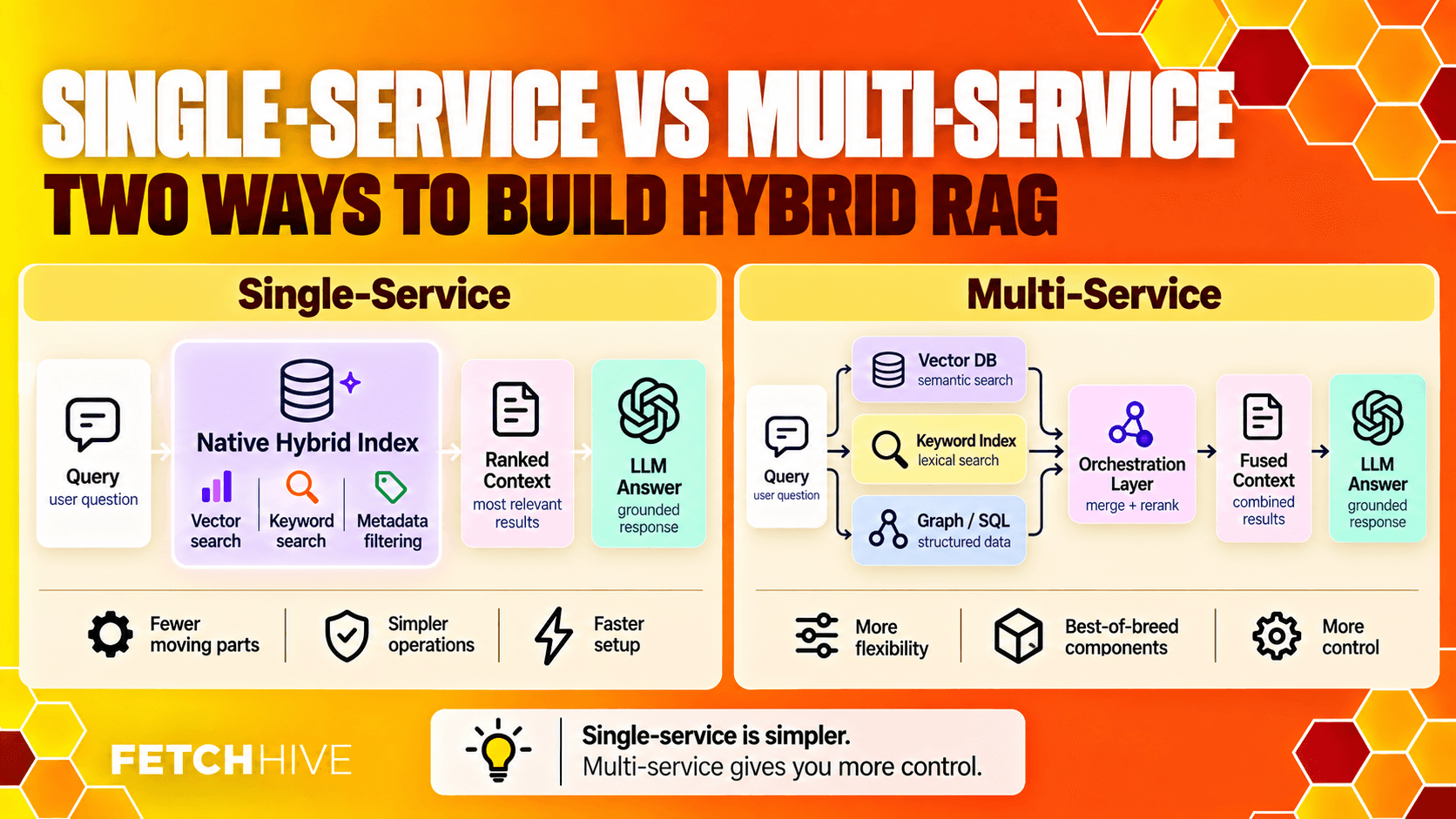
There are two common ways to build the retrieval layer.
Single-service hybrid index. One platform handles keyword search and vector search natively. This is simpler to operate and often enough for a large number of RAG use cases.
Multi-service retrieval. Separate systems handle different retrieval methods, with an orchestration layer coordinating them. This gives you more control and lets each backend do what it is good at, but naturally adds more moving parts.
The multi-service version normally follows a fan-out-and-fuse pattern: the query goes to multiple retrieval backends in parallel, each returns candidates, a fusion layer combines the lists, and an optional reranker chooses the final evidence.
This is where the architecture can get silly if you are not careful. More retrievers do not automatically mean comprehensive coverage. Every additional backend adds latency, failure modes, operational context, monitoring, and another place for data quality to drift.
Start with the smallest combination that fixes an observed retrieval problem. If keyword plus vector search handles 95% of your queries, congratulations. You do not win extra points for adding three databases and a graph because the diagram looks expensive.
How to Build a Hybrid RAG System
If I were adding hybrid retrieval to an existing RAG system, I would build it in roughly this order.
1. Inventory your data sources. Separate structured data, unstructured data, logs, documents, databases, APIs, and anything else the system may need to search.
2. Create a real query set. Collect user questions, exact identifiers, vague semantic questions, mixed queries, and edge cases. Do this before tuning anything.
3. Get semantic retrieval working. Choose sensible embedding models, generate vector embeddings, create the vector index, and verify that semantic similarity returns relevant documents.
4. Add keyword retrieval. Build keyword indexes for the same corpus or the subset where exact matching matters. Test phrase matching, synonyms, casing, and identifiers.
5. Run both retrievers in parallel. Keep their outputs separate initially so you can see what each retrieval mechanism contributes.
6. Add fusion. Start with reciprocal rank fusion unless you have a good reason not to. It is a much saner baseline than guessing score weights.
7. Rerank the strongest candidates. A reranker can clean up noisy merged results before context reaches the language model.
8. Limit the final context. More context is not automatically richer context. Pass the evidence that is most likely to help.
9. Evaluate answer quality. Measure retrieval quality and generation separately so you know whether failures came from search or from the model.
10. Add more retrieval methods only when needed. Graphs, APIs, SQL, and agentic retrieval should solve observed gaps, not architectural boredom.
If your existing pipeline is already returning weak evidence, I would fix that before adding more moving parts. My RAG performance guide goes much deeper on debugging retrieval, chunking, reranking, latency, and evaluation.
What to Measure: Retrieval Quality Before Vibes
Hybrid RAG only matters if it produces better results. “It feels better in the demo” is not a key metric.
At minimum, I would track a small set of key metrics:
Recall@k: did the relevant information appear somewhere in the candidate set?
Precision@k: how much of what you retrieved was actually useful?
Mean Reciprocal Rank: how high did the first relevant result appear?
Retriever contribution: did keyword search, vector search, or another source actually provide the winning evidence?
Latency per retriever: which part of the retrieval process is slowing the request down?
Fusion and reranking time: are you spending 700 ms polishing a result set that was already good enough?
Grounding and factual accuracy: did the final answer stay supported by the retrieved information?
End-to-end response quality: did the user actually get an accurate answer they can use?
This separation matters. If retrieval is bad, swapping the large language model may do absolutely nothing. If retrieval is excellent but generation is poor, rebuilding your keyword index is equally pointless.

The entire point of evaluation is to stop guessing.
The reason is simple: better retrieval should produce more accurate responses, not just prettier dashboards. If your hybrid setup adds 400 ms and does not improve accurate answers or factual accuracy, it is probably not earning its keep.
Common Hybrid RAG Mistakes
Hybrid systems give you more options. Unfortunately, options are also another way of saying “more things you can configure badly.”
Treating vector search as magic. Error codes, invoice numbers, exact product names, and legal references often need exact matches. Semantic meaning is useful, but it is not psychic.
Letting one retriever dominate. Bad fusion weights can make your “hybrid” setup behave almost exactly like one search type.
Indexing different source sets. If a document exists in the keyword index but not the vector index, or vice versa, you can get confusing gaps that look like ranking problems.
Ignoring duplicate results. Multiple retrieval methods often find the same document. Deduplicate before assembling context.
Using vague metadata. Version, date, source authority, access permissions, and product area can matter as much as similarity.
Sending everything to the LLM. Comprehensive coverage is not the same as dumping every relevant result into the prompt.
Ignoring observability. If you cannot see which retriever produced which chunk, debugging becomes an afternoon of staring at the final answer and making theories.
That last one is especially important. A production RAG system needs visibility into the retrieval process, not just the generated answer. Otherwise the model gets blamed for problems created three stages earlier.

When Hybrid RAG Is Actually Worth It
Hybrid RAG is particularly useful when your users mix exact and conceptual queries.
Technical documentation and support: error codes and API names need keyword precision; troubleshooting questions need semantic understanding.
Enterprise knowledge search: policies, PDFs, internal docs, structured systems, and multiple sources rarely behave nicely inside one retrieval approach.
Legal and compliance: exact citations matter, but users also ask conceptual questions about obligations and exceptions.
Financial research: tickers, filing references, dates, entities, and semantic analysis all appear in the same workflow.
Healthcare and scientific knowledge: exact terminology matters alongside broader semantic retrieval, although high-stakes applications need considerably stronger validation and human oversight.
For a small FAQ bot with twenty clean pages, hybrid retrieval may be unnecessary. For an internal search system covering years of documentation, tickets, product data, and changing policies, it starts making a lot more sense.
The architecture should follow the query complexity, not the trend cycle.
Hybrid Retrieval Is Becoming More Adaptive
The next step is not “add even more retrievers.” It is making the system better at deciding which retrieval strategies a query actually needs.
A query containing an exact ticket number may only need keyword search and a metadata filter. A vague research question may benefit from semantic search across multiple sources. A question involving relationships may need graph retrieval. A complex task may need several searches, verification, or an agent that decides what to retrieve next.
That is where hybrid RAG starts overlapping with agentic RAG. The retrieval layer is no longer a fixed sequence; the AI system can choose tools, run multiple retrieval passes, inspect relevant results, and adapt when the evidence is weak.
If you want the deeper version of that, my Agentic RAG guide covers planning, routing, retrieval, verification, and the point where agentic complexity is actually justified.
We are also seeing search engines and vector databases support more search types natively, so some of what currently requires custom orchestration will become boring infrastructure. Good. Boring infrastructure is usually a sign that something is maturing.
That does not require mystical artificial intelligence. It is mostly good routing, evaluation, and feedback. The best AI systems are often the ones that know when not to use every tool they have.
Where Fetch Hive Fits
This is the bit where I mention the product, but hybrid retrieval is actually a good example of why I built Fetch Hive in the first place.
Once a RAG workflow uses multiple retrieval approaches, reranking, tools, models, fallbacks, and evaluation, the interesting problem is no longer “can I call a vector database?” It is whether you can see what happened across the whole workflow when an answer goes wrong.
Fetch Hive lets you build multi-step AI workflows and agents, connect retrieval and tool calls, compare models, and trace the steps, latency, cost, and outputs in one place. That makes it useful for experimenting with hybrid retrieval without turning every change into another pile of glue code.
You do not need Fetch Hive to build hybrid RAG. You do need some way to test it properly. Whatever stack you use, make sure you can inspect the retrieval decisions instead of treating the final response like magic.

Conclusion: Stop Making One Retriever Do Every Job
Hybrid RAG is not interesting because it contains more technology. It is interesting because user queries are messy and different retrieval methods have different strengths.
This is also why hybrid retrieval is becoming a standard part of modern AI systems rather than a niche search trick. It gives the retrieval layer more than one way to find evidence without asking the model to compensate for weak search.
Keyword search gives you exactness. Vector search gives you semantic similarity. Knowledge graphs can add relationships when relationships genuinely matter. Fusion and reranking turn those candidates into a smaller set of useful evidence.
Start simple: keyword plus vector search, reciprocal rank fusion, a real evaluation set, and proper tracing. Add multiple retrieval strategies only when the data tells you they improve the result.
The goal is not the most impressive architecture. The goal is to retrieve the right information before the model gets a chance to be confidently wrong about it.
Share this post


